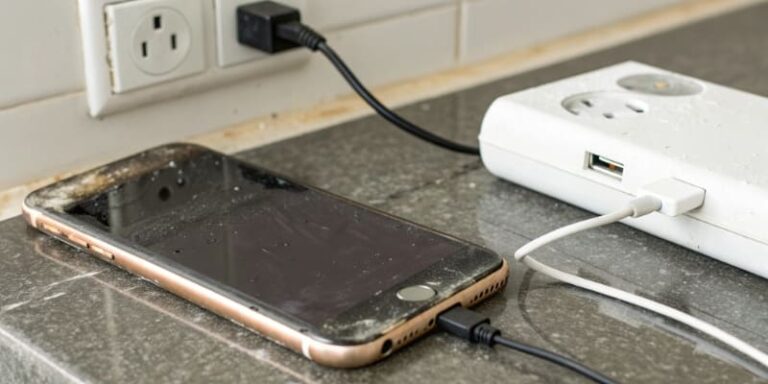
You see "IP68" on a battery and assume it's invincible against water. But what if that promise has limits you don't know, risking your expensive device?
IP68 means a battery is fully dust-tight and can handle continuous water immersion beyond 1 meter. However, the exact depth and duration are defined by the manufacturer, not a universal standard. This rating is for fresh water only and applies only to undamaged products.
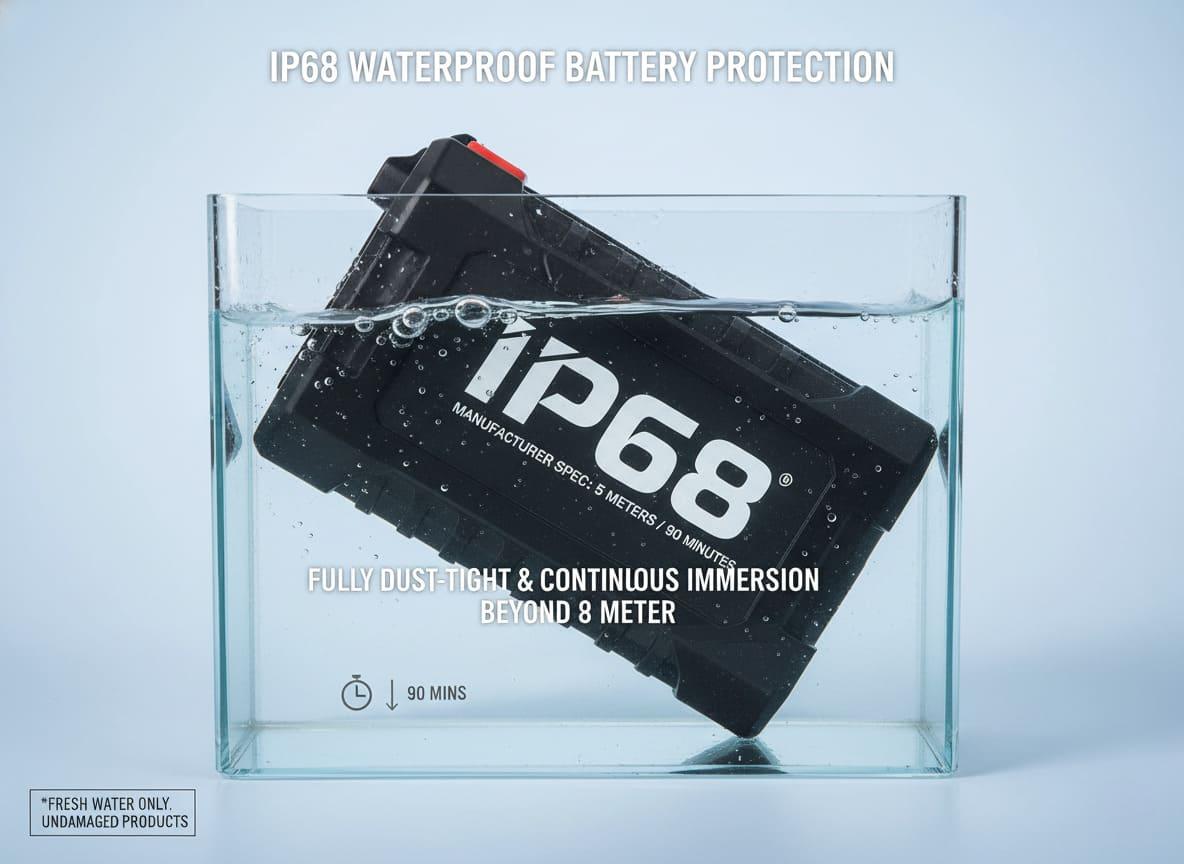
That’s the quick answer, but the details are where things can get tricky for product developers and procurement managers. An IP rating is more than just a number; it's a specific promise of performance under very specific conditions. Misunderstanding these details can lead to costly product failures and unhappy customers. So, let’s dig into the specifics to make sure you're getting the protection you actually need for your application.
What Are the Real Standards for IP68 Depth and Time, and Why Do They Change So Much?
You need a specific waterproof level for your product. But every supplier seems to have their own IP68 definition, making direct comparison difficult and confusing.
The international standard, IEC 60529, defines IP68 as protection against continuous immersion under conditions specified by the manufacturer, which must be more severe than IP67 (1 meter for 30 minutes). This flexibility allows manufacturers to tailor the rating to a product’s specific design and intended use.
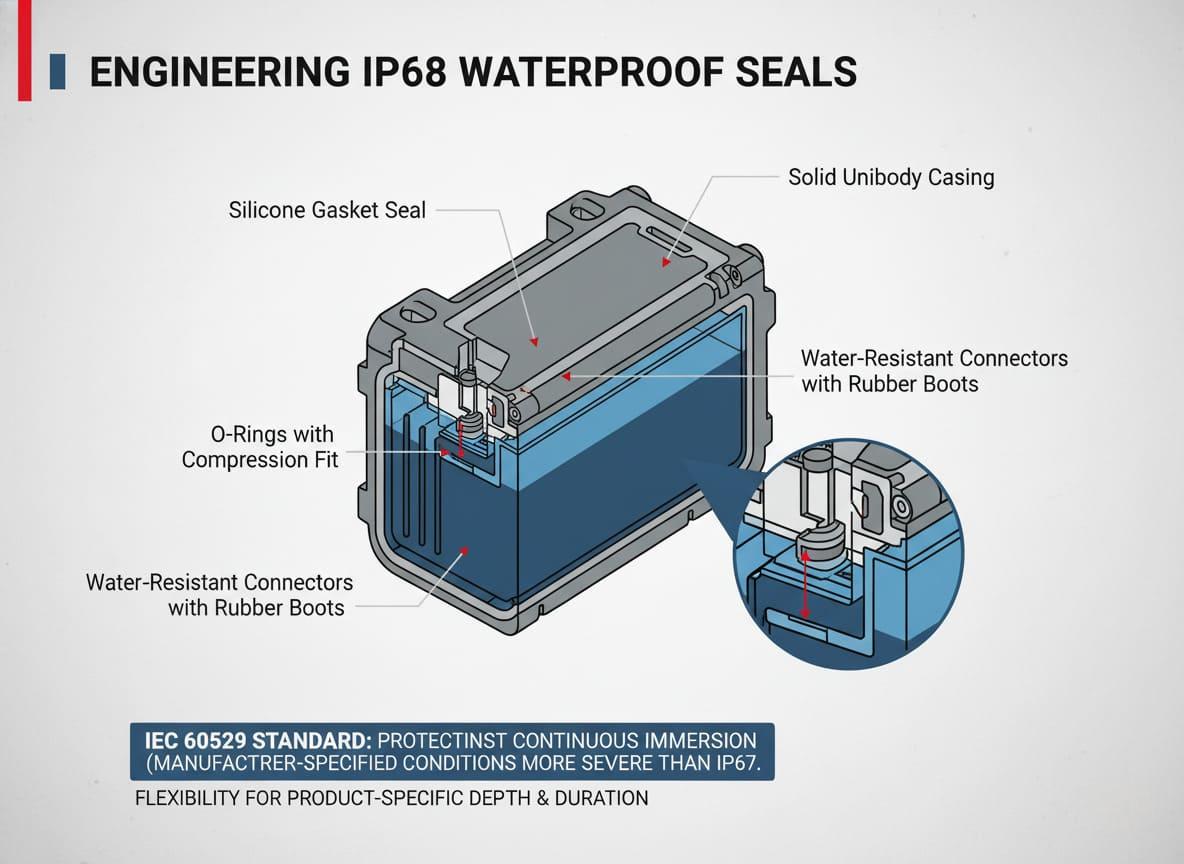
The reason for this variation is rooted in both engineering and economics. Let's break it down. The "IP" code system gives us a clear framework, but it has built-in flexibility.
Understanding the Standard
The first digit (6) in IP68 refers to solids. A "6" is the highest level, meaning the enclosure is completely dust-tight. No dust can get in. This part is simple and consistent.
The second digit (8) refers to liquids. This is where it gets interesting. Here’s a simple comparison:
- IPx7: The device can be submerged in up to 1 meter of fresh water for 30 minutes. This is a very specific and universal test.
- IPx8: The device can be submerged in more than 1 meter of water for a duration specified by the manufacturer.
The standard intentionally leaves the exact depth and time for IP68 open. Why? Because the needs of a deep-sea sensor are completely different from a smartphone that might just fall into a deep sink.
Why Manufacturers Define Their Own Standards
There are a few key reasons why you'll see different IP68 ratings, like "3 meters for 60 minutes" from one brand and "1.5 meters for 30 minutes" from another.
| Factor | Description | Impact on IP68 Rating |
|---|---|---|
| Intended Use | A battery for a diver's watch needs to withstand high pressure for long periods. A battery for a rugged tablet just needs to survive a fall into a river. | The rating is designed to match the most likely real-world scenarios for that product. |
| Material Costs | Achieving higher water pressure resistance requires stronger materials, thicker casings, and more advanced seals (like O-rings and waterproof adhesives). | Manufacturers balance performance with cost. Over-engineering for a deeper rating than necessary increases the final product price. |
| Product Design | The shape of the product, the number of openings (like ports or buttons), and the type of seals used all affect how well it can resist water pressure. | Complex designs are harder to seal, so the manufacturer may specify a more conservative depth or duration. |
When I work with clients like Michael, who develops high-end medical devices, we don't just pick an off-the-shelf rating. We start by asking: "What specific environment will this device operate in?" Then, we custom-engineer the battery enclosure to meet and exceed that exact requirement, providing a tested and certified solution that fits the product perfectly.
Does an IP68 Rating Protect Your Battery in the Pool or the Ocean?
Your new device is IP68 rated, and you think it's ready for the beach. But you should know that salt and chlorine are very corrosive and can ruin your battery's seals.
No, an IP68 rating does not guarantee protection in salt water or chlorinated water. The tests are performed in controlled, fresh water environments. Corrosive and chemical-filled liquids can degrade the seals that provide waterproof protection, leading to potential failure.
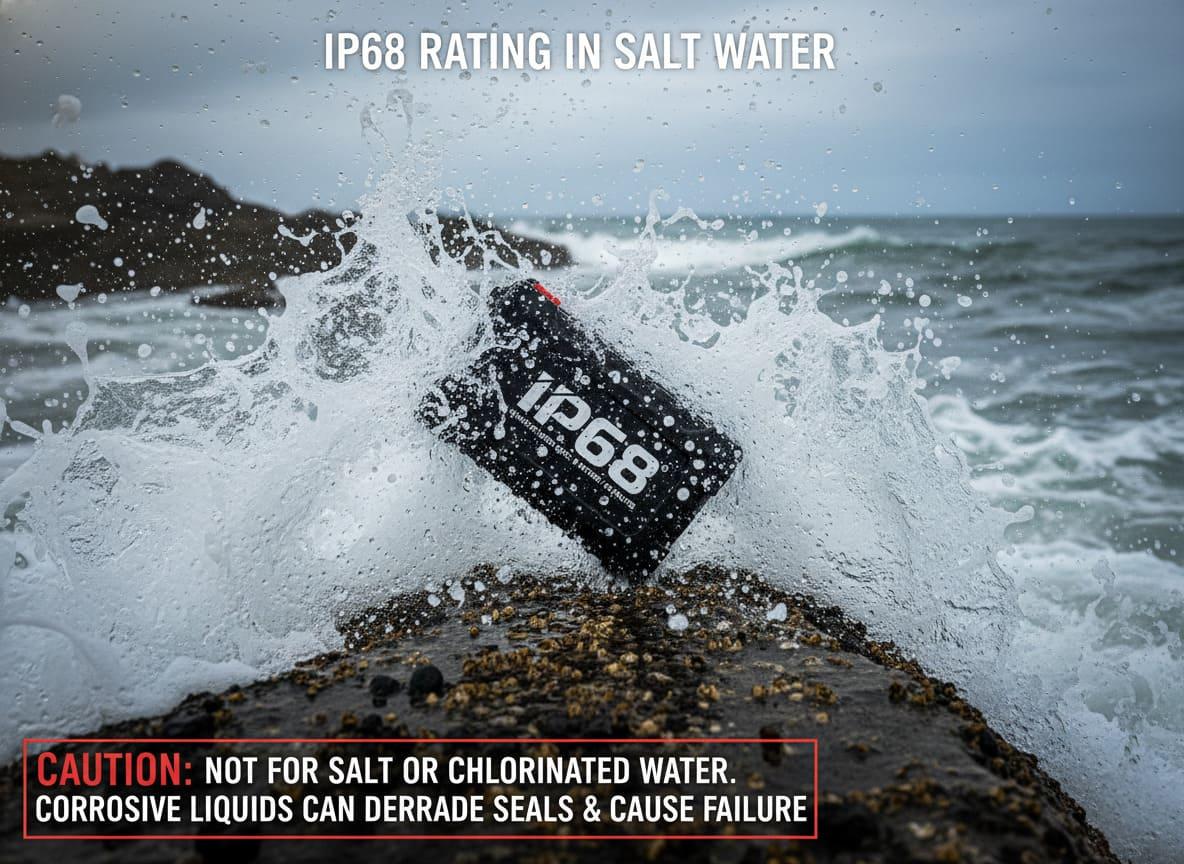
This is one of the most common and costly misunderstandings about IP ratings. The official IEC 60529 standard is very clear about the testing conditions: the tests are conducted in still, clean, fresh water at a standard temperature. The real world, however, is rarely so clean.
The Problem with Salt Water
Salt water is a battery's enemy for two main reasons.
- Corrosion: Salt is extremely corrosive to metals. If even a tiny amount gets past the seals, it can start to eat away at the sensitive electronic components of the battery management system (BMS) and the battery terminals.
- Conductivity: Salt water is much more conductive than fresh water. This means if it breaches the enclosure, it is far more likely to cause a short circuit, which can permanently damage the battery and the device it powers.
The Danger of Chlorinated Water
Your swimming pool presents a different kind of threat. Chlorine and other pool chemicals are designed to break down organic materials, and over time, they can have a similar effect on the rubber gaskets and adhesives used to waterproof your device. These chemicals can cause the seals to become brittle, crack, or lose their elasticity, creating a pathway for water to get in.
I remember a client who was developing a line of waterproof personal fitness trackers. Their first prototypes passed IP68 tests in the lab with no problem. But when they sent them out for real-world testing with a swim team, several units failed within weeks. The culprit was the constant exposure to chlorinated pool water, which degraded the seals much faster than their fresh water tests predicted. We had to work with them to source a higher-grade, chemical-resistant sealing material for their battery compartment to solve the problem.
So, what's the takeaway? If your IP68-rated device is exposed to salt water or pool water, it's a good practice to rinse it thoroughly with clean, fresh water as soon as possible and let it dry completely. The IP rating is a safety net against accidents, not a license for continuous use in harsh liquid environments.
What Happens to an IP68 Rating After You Drop Your Device?
You accidentally dropped your rugged, IP68-rated device. It looks fine and still works. But a tiny, unseen crack could have completely destroyed its water resistance, setting it up for failure later.
Any physical damage, such as a crack or deep scratch from a drop, immediately voids the IP68 rating. The waterproof and dustproof protection relies entirely on the structural integrity of the casing and its seals. A breach of any size compromises the entire system.
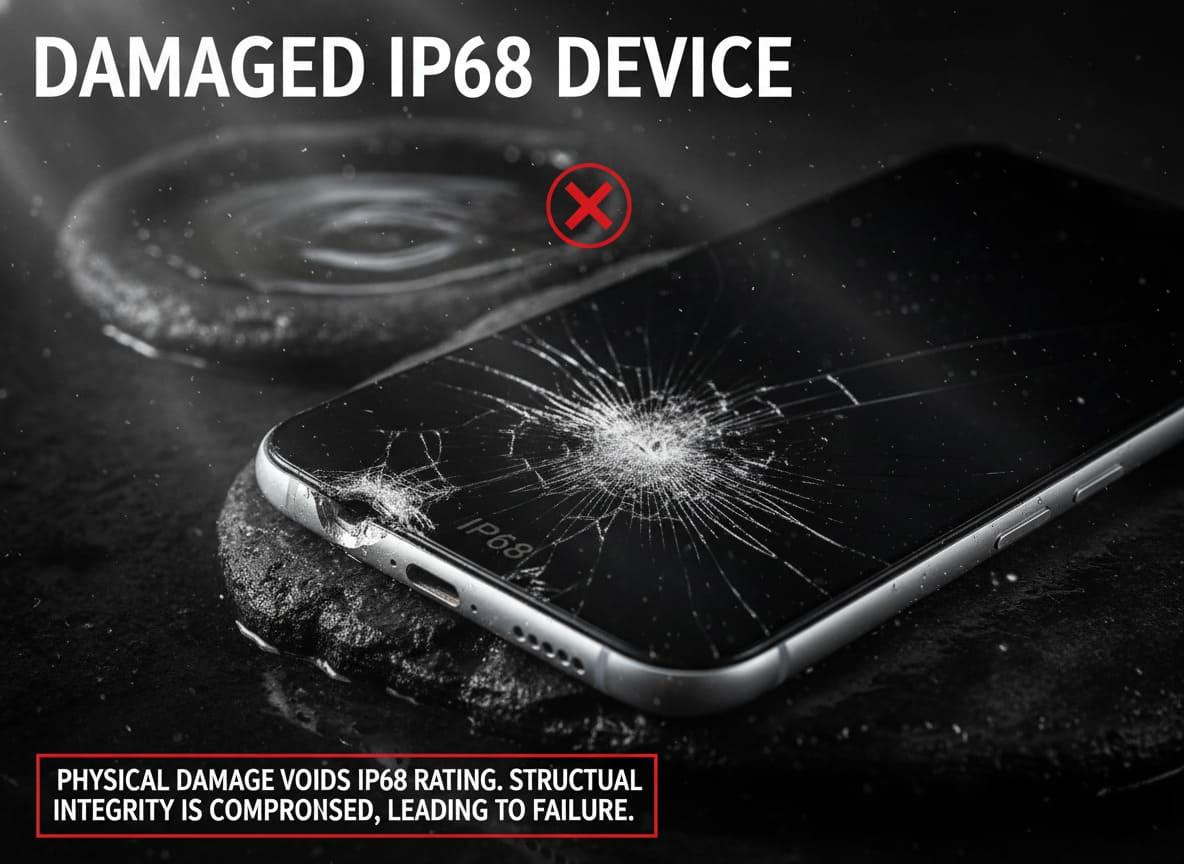
Think of an IP-rated enclosure like a submarine. Its ability to protect what's inside depends on its hull being perfectly intact. Even a very small hole can lead to a catastrophic failure under pressure. The same principle applies to your battery's housing.
How a Drop Compromises the Seal
The protection against water and dust isn't magic; it's the result of precise physical engineering.
- Gaskets and O-Rings: These are tiny rubber seals placed in grooves around openings like battery doors and charging ports. They compress to form a watertight barrier.
- Adhesives: Many modern devices use strong, waterproof adhesives to bond parts of the casing together, like the screen to the body.
- Case Integrity: The plastic or metal housing itself acts as the main barrier. It must be free of any cracks or deformities.
When you drop a device, the shock of the impact can cause several problems, even if you don't see a visible crack:
- Micro-fractures: The casing can develop tiny cracks that are almost invisible to the naked eye but are more than large enough for water molecules to pass through.
- Deformed Housing: The impact can slightly warp the case, creating tiny gaps between sealed parts.
- Dislodged Seals: A gasket can be knocked out of its groove or lose its compression, breaking the seal.
I worked on a project for a company that makes GPS trackers for industrial equipment. They needed a battery solution that could withstand rough handling. During our testing phase, we found that even a drop from one meter onto concrete was enough to compromise the IP68 seal on some early prototypes, even when the casing looked undamaged. This is why for truly rugged applications, we focus not just on the seal itself, but also on shock absorption and robust housing materials. We ensure the design can handle impacts without affecting the seal's integrity. The IP rating is only valid for a product in its original, undamaged condition. Once it's dropped, all bets are off, and you should no longer trust its ability to protect against water.
IP67 vs. IP68: What’s the Real-World Difference for Your Battery?
You're choosing between IP67 and IP68 for your new product. Is paying more for IP68 worth the cost, or is IP67 good enough for your actual needs?
In the real world, IP67 is for protection against accidental, temporary immersion, like dropping a device in a puddle. IP68 is for devices intended for deliberate and sustained use in water, like swimming trackers or underwater sensors. The choice depends on use-case, not just the higher number.
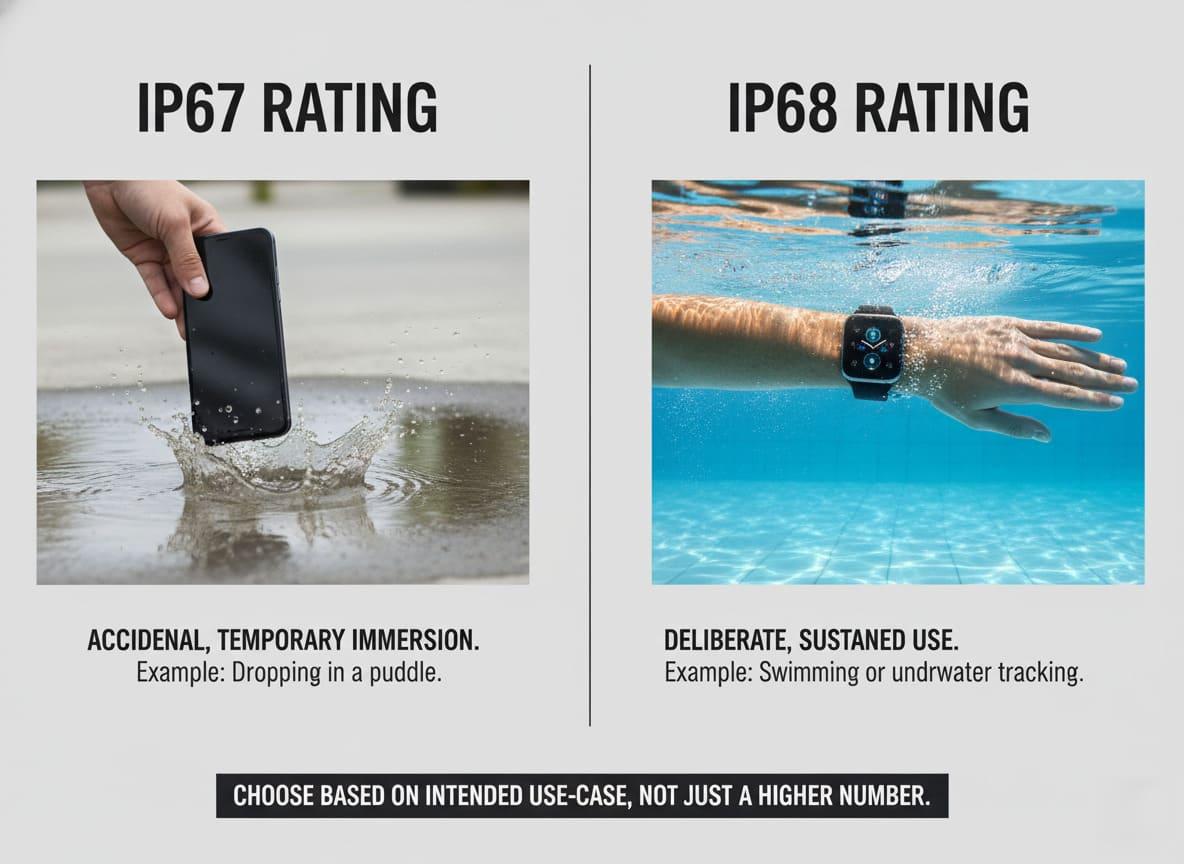
Choosing the right IP rating is a critical design decision. It directly impacts manufacturing costs, product durability, and marketing claims. Simply choosing the "best" rating isn't always the smartest business decision. The key is to match the rating to the product's intended application.
A Practical Comparison
Let's look at what these ratings mean for a user in practical terms.
| Feature | IP67 | IP68 |
|---|---|---|
| Standard | Submersion up to 1 meter for 30 minutes. | Submersion beyond 1 meter for a duration specified by the manufacturer. |
| Best For | Accidental exposure. | Intentional and prolonged exposure. |
| Common Use Cases | Smartphones, Bluetooth speakers, personal care devices. | Smartwatches for swimming, rugged outdoor gear, some medical devices, underwater cameras. |
| Design Philosophy | "Survival." The goal is to survive an accident. | "Performance." The goal is to function reliably underwater. |
| Cost Implication | Lower. Easier and cheaper to design and manufacture. | Higher. Requires more robust materials, better seals, and more rigorous testing. |
Making the Right Choice
When a client comes to us at Litop, our first question is always about the application.
- Is your device a personal grooming tool that might be dropped in the sink? If so, IP67 is likely sufficient. It provides excellent protection against the most common accidents without adding unnecessary cost.
- Is your device a wearable health monitor that a patient will wear while showering? Here, IP68 becomes more important. You need to ensure it can withstand more than just a quick drop in water. We would work with you to define a specific IP68 requirement, for example, "waterproof to 1.5 meters for 60 minutes," to match that need.
- Is your device an industrial sensor that will be permanently installed outdoors in a wet environment? This calls for a robust IP68 rating, potentially even higher ratings like IP69K (for high-pressure, high-temperature water jets) depending on the cleaning procedures used.
The practical advantage of IP68 is confidence. It allows you and your customers to use the device in or around water without worry. The advantage of IP67 is that it provides a very strong level of protection for a majority of everyday situations at a more accessible price point. The right choice is the one that meets your product's real-world needs.
Conclusion
IP68 offers excellent water protection, but "continuous immersion" has limits. It means protection beyond 1 meter in fresh water, with specifics set by the manufacturer. It doesn't cover salt water or damaged devices. Ultimately, choosing between IP67 and IP68 depends entirely on your product’s real-world application.