Choosing the wrong battery for your boat can lead to total power failure at sea. Imagine your navigation and communication systems dying from water damage, leaving you stranded. Understanding IP ratings is key to ensuring reliability and safety.
For marine use, an IP68-rated lithium battery is the best choice. It offers the highest protection against continuous water immersion under pressure, which is vital for boating. IP67 is a decent alternative for less exposed areas, but IP65 is not sufficient for critical marine power systems.
The right choice is not just about picking the highest number. IP ratings are a standardized system to measure how well a device is protected from both solids (like dust) and liquids (like water). The first digit refers to dust protection, and the second refers to water protection. For marine use, we focus on the water protection number. But what do these numbers really mean when you are out on the open water? Let's break it down to see what is best for your vessel.
What are the specific corrosion risks from saltwater for different IP-rated batteries?
You think your new IP-rated battery is completely safe, but saltwater is a different kind of threat. Corrosion can silently destroy seals and connections, leading to catastrophic failure when you least expect it. Knowing how saltwater affects battery materials is vital for long-term safety.
Saltwater dramatically accelerates corrosion, especially on metal parts like connectors and seals. Higher IP ratings like IP67 and IP68 use more robust sealing methods and corrosion-resistant materials. IP65-rated batteries often have seals that degrade quickly, allowing saltwater ingress and causing terminal corrosion and internal damage.
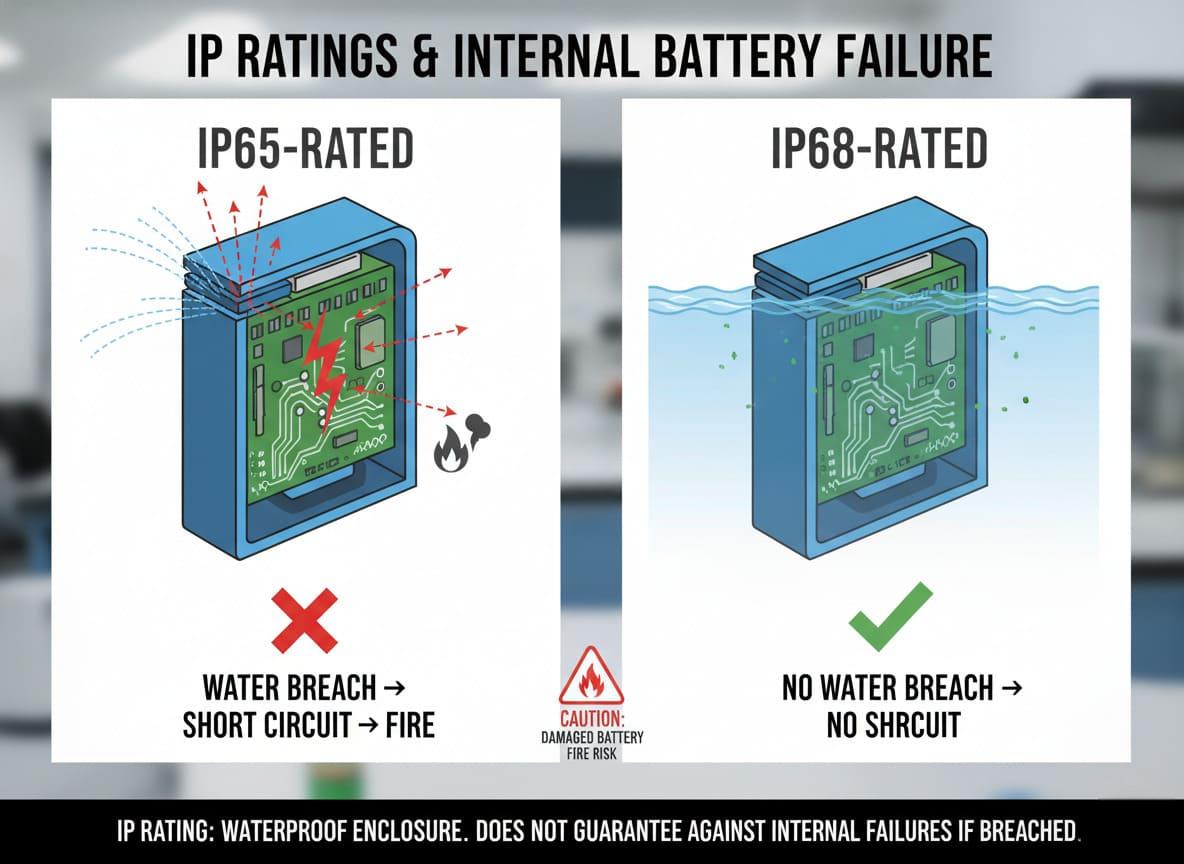
Saltwater is not the same as freshwater. The salt it contains makes it highly conductive and incredibly corrosive to metals. When you are looking at batteries for a marine environment, you have to consider how the enclosure and its components will stand up to this constant, corrosive threat.
Material Integrity Under Attack
Most battery casings are made from durable plastics like ABS or polycarbonate, which resist saltwater fairly well. The real weak point is the seams and seals. These are often made from rubber or silicone gaskets. Over time, constant exposure to saltwater, combined with sun and temperature changes, can make these seals brittle or cause them to lose their shape. A lower IP65 rating relies on simple gaskets that may protect against a light splash but are not designed to stop corrosive saltwater mist from getting in over weeks and months. In contrast, IP67 and IP68 ratings demand much more robust sealing designs, like compressed O-rings or even fully potted enclosures where the internal components are completely encased in a waterproof resin.
The Electrochemical Threat
Saltwater also enables a process called galvanic corrosion. This happens when two different types of metal are in contact while wet with saltwater. The saltwater acts as an electrolyte, and one metal will start to corrode much faster than the other. This is a huge problem for battery terminals and connector pins, which are often made from different metals. An IP65-rated battery may have exposed or poorly sealed terminals that are highly vulnerable. At Litop, our IP68 batteries often use marine-grade stainless steel fittings and specialized coatings to prevent this kind of destructive chemical reaction.
| IP Rating | Sealing Method | Common Materials | Saltwater Corrosion Risk |
|---|---|---|---|
| IP65 | Simple gaskets, low compression | Standard polymers, basic metal terminals | High: Seals can fail from spray, allowing corrosive mist to enter. Terminals are very vulnerable. |
| IP67 | Compression gaskets, O-rings | Reinforced polymers, better-quality fittings | Moderate: Protects from short-term immersion, but prolonged exposure can still degrade seals. |
| IP68 | Robust O-rings, welded seams, potting | High-grade polymers, stainless steel | Low: Designed to resist saltwater corrosion through superior materials and sealing techniques. |
Does an IP rating only mean external waterproofing, or does it prevent internal shorts and fires?
You bought a waterproof battery, assuming it is completely safe from any water damage. But if water finds a way inside, it can cause a short circuit or even a fire. This is a disaster on a boat. An IP rating is your first line of defense, but it does not tell the whole story.
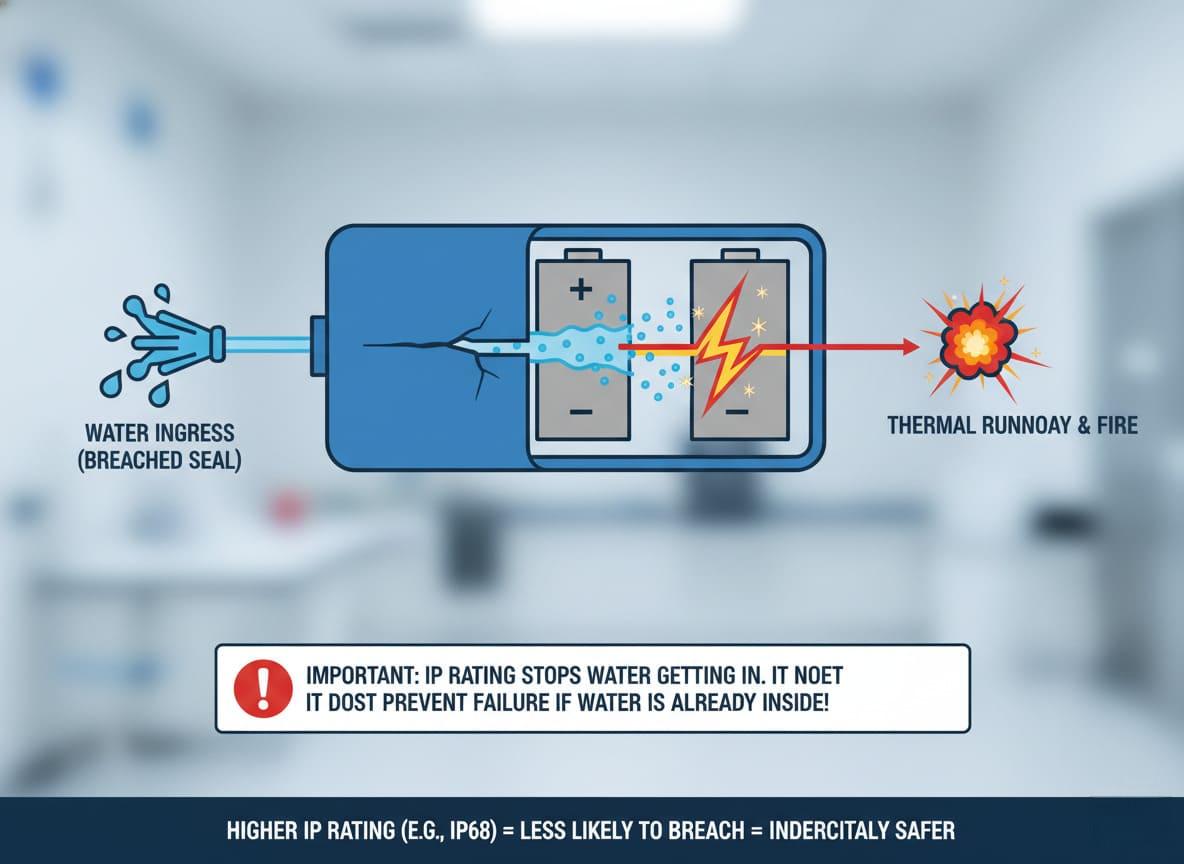
An IP rating certifies the enclosure's ability to stop water from getting in. It does not directly guarantee against internal shorts or fires if water does breach the casing. A higher rating like IP68 simply makes a breach far less likely, thus indirectly preventing these dangerous failures.
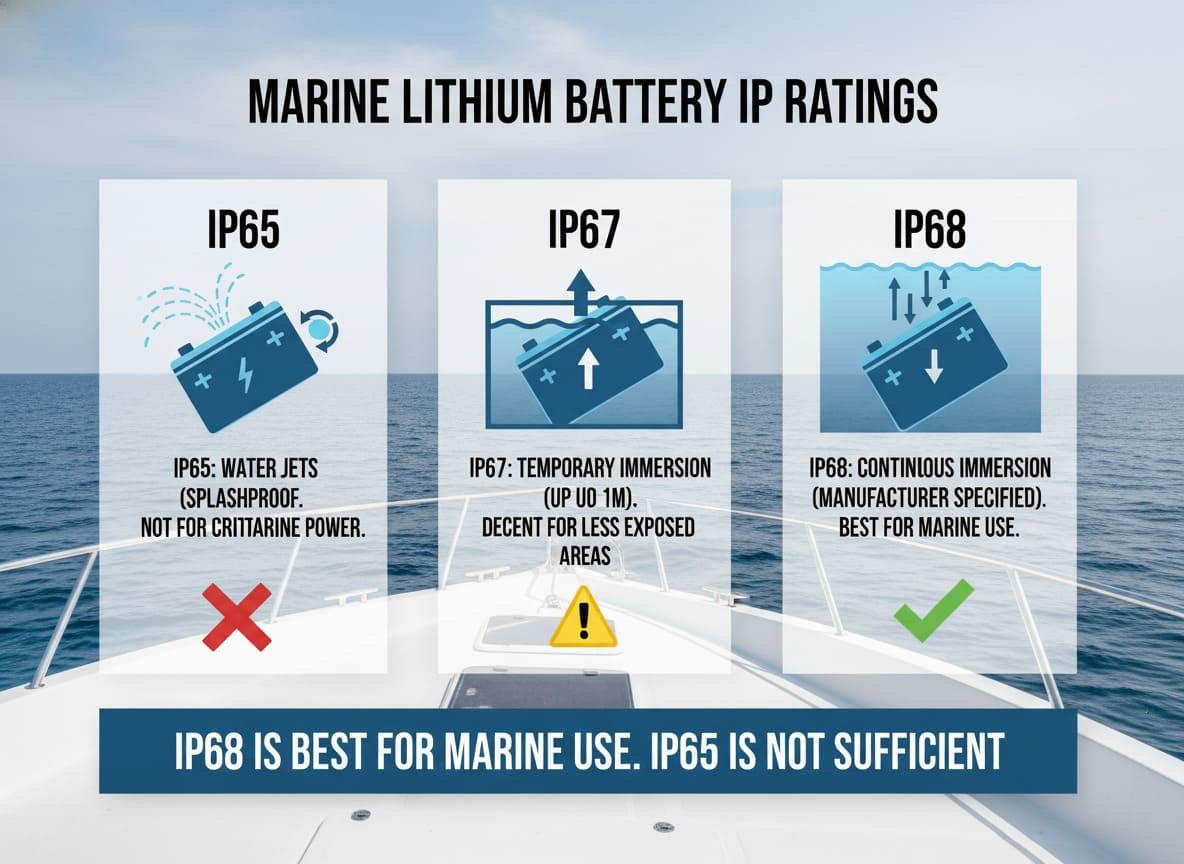
It is critical to understand that an IP rating is a measure of the physical barrier—the box. It tells you how good that box is at keeping water out. It does not describe what happens if the barrier fails. The safety of the battery then depends on its internal design, especially the Battery Management System (BMS).
The Chain of Failure
When a battery fails due to water, it usually happens in a few steps.
- Water Ingress: First, water has to get inside. This might happen because a seal has degraded, the case is cracked from an impact, or the battery's IP rating was not sufficient for the conditions.
- Internal Contamination: The water, especially conductive saltwater, gets onto the circuit boards and between the battery cells. It creates electrical pathways where they should not exist.
- Short Circuit: This new pathway allows electricity to flow uncontrollably between the positive and negative terminals. This is a short circuit, and it releases a huge amount of energy very quickly.
- Thermal Runaway and Fire: The massive current from the short circuit generates intense heat. This heat can cause the lithium battery cells to become unstable in a process called thermal runaway. The cells can vent flammable gas and electrolytes, often leading to smoke and a dangerous fire. In the confined space of a boat, this is a nightmare scenario.
The Role of the BMS
This is why a high-quality BMS is just as important as a high IP rating. A well-designed BMS is the brain of the battery pack and acts as a crucial second layer of safety. I remember working with a client, Michael, who was developing a new marine sonar device. He was worried about this exact issue. We explained that our IP68 housing was his first shield, but the advanced BMS inside was his second. Our BMS is designed to constantly monitor for anomalies like a sudden drop in voltage (indicating a short) or a rapid temperature increase. If it detects a dangerous condition, it can instantly cut off the power, isolating the battery and preventing a thermal runaway event. For true marine safety, you need both: a high IP rating to keep water out and a smart BMS to protect you if the worst happens.
What extra protection is needed if I use an IP65 battery on my boat or RV?
You already have an IP65 battery, and it seems good enough for your boat. But a single large wave over the side or a leaky pipe in the bilge could easily overwhelm it. This could leave you without power when you need it most. You must add extra layers of protection to make an IP65 battery viable.
If you must use an IP65 battery, install it inside a secondary waterproof enclosure, often called a dry box. You must also mount it high above the bilge and away from any potential spray or leaks. Regularly inspect the battery and its connections for any sign of moisture.
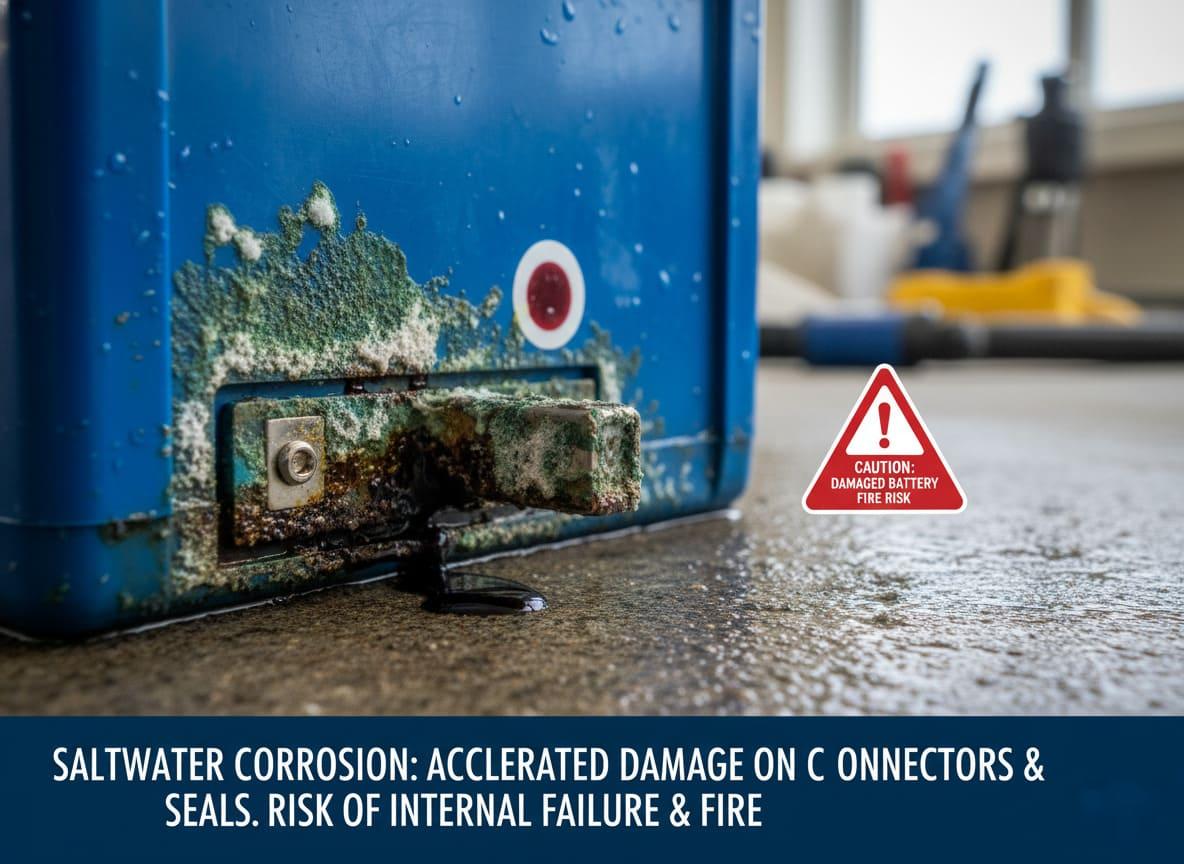
First, let's be clear about what IP65 means. It protects against low-pressure water jets from any direction. Think of rain or being sprayed lightly with a hose. It is absolutely not designed to handle pooling water in a bilge or being submerged, even for a second. Using one on a boat without extra precautions is risky, especially for essential systems like engine starters, navigation, or bilge pumps.
Creating a "Dry Zone"
The most important step is to place the IP65 battery inside a completely separate waterproof box. You can find enclosures that have their own IP67 or IP68 rating. This gives you a two-layer defense.
- The Enclosure: The secondary box must seal completely. Look for one with a strong latch and a rubber gasket.
- Cable Glands: Any wires going in or out of the box must pass through waterproof cable glands. These are special fittings that tighten around the cable to create a watertight seal. Simply drilling a hole for the wires will defeat the purpose of the box.
- Ventilation: Batteries can produce a small amount of heat when charging or discharging. In a completely sealed box, this heat can build up. For high-power applications, you might need a box with a special vent that allows air and pressure to equalize but keeps water out.
Strategic Installation and Maintenance
Where and how you install the battery also matters.
- Mounting: Always mount the battery box as high as possible. Never place it on the floor of a compartment where water can collect. Secure it firmly so it cannot slide or bounce around in rough seas.
- Wiring: Use marine-grade tinned copper wire, which resists corrosion much better than standard copper wire. All connections should be sealed with adhesive-lined heat-shrink tubing to keep moisture out.
- Inspection: Make it a habit to check inside the box regularly. Look for any signs of water droplets or condensation. Also, check the battery terminals for any white or greenish powder, which is a clear sign of corrosion starting.
Honestly, as a manufacturer, I believe the cost and hassle of properly protecting an IP65 battery often outweigh the savings. A factory-sealed IP68 battery from a trusted supplier like Litop is almost always a more reliable and safer long-term solution.
What are the real-world advantages of IP68 over IP67 in marine use?
IP67 and IP68 ratings both sound very waterproof. It is easy to think the higher number is just a marketing trick. But that one-digit difference could mean your systems work after being submerged for hours versus failing after just 30 minutes. Understanding this practical gap ensures you invest in the right level of safety.
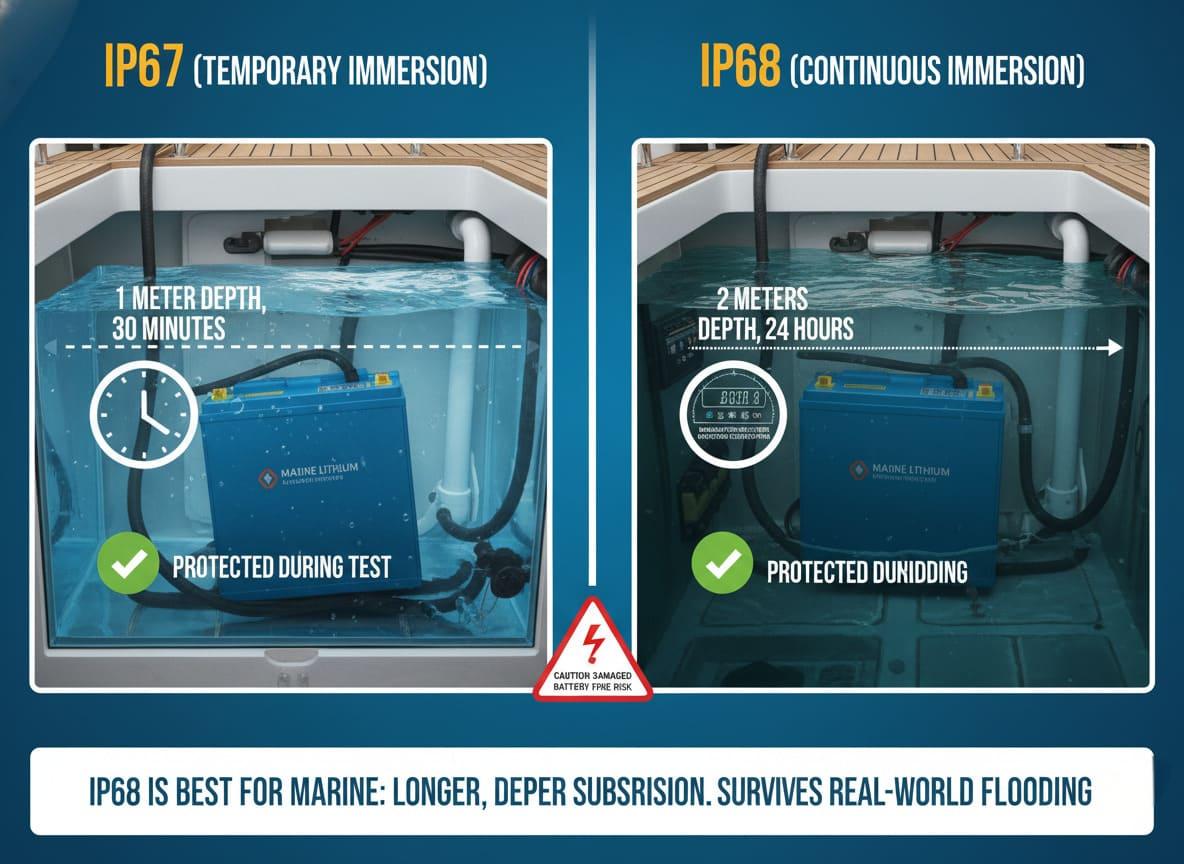
The key difference is duration and pressure. IP67 guarantees protection during immersion up to 1 meter deep for 30 minutes. IP68 guarantees protection during continuous immersion, often at greater depths and for longer periods, as specified by the manufacturer. For marine use, this means IP68 survives real-world scenarios like prolonged bilge flooding.
Let's look beyond the technical definitions. An IP67 rating means the product passed a specific lab test: submersion in 1 meter of still water for 30 minutes. It is a pass/fail test for a very controlled situation. IP68 is different. The "8" signifies protection against continuous submersion under conditions specified by the manufacturer. This means we, as the manufacturer, must define and test for a much tougher, more realistic scenario. For example, at Litop, our IP68 marine batteries are often tested to survive at 2 meters for 24 hours. That is a huge step up from the IP67 standard.
Scenarios Where IP68 Excels
In a real marine environment, the IP68 rating provides a critical margin of safety that IP67 cannot match.
- Bilge Flooding: This is a common and dangerous situation. A failed bilge pump, a damaged thru-hull fitting, or even heavy seas can cause the bottom of your boat to fill with water. This water will not drain away in 30 minutes. An IP67-rated battery located in the bilge is on a timer to failure. An IP68 battery is designed to continue operating even when submerged for hours, giving you time to fix the problem.
- Deck-Mounted Equipment: Consider a battery for a trolling motor, an anchor winch, or an external lighting system. These are constantly hit with spray and waves. The force of a crashing wave can create pressure far greater than a simple 1-meter submersion. The more robust seals and construction of an IP68 battery are built to handle this dynamic pressure.
- High-Pressure Washdowns: When you clean your boat, you might use a high-pressure washer. This can easily force water past the seals of an IP67-rated enclosure. IP68 batteries are generally built to a higher standard and are more resilient against this.
| Scenario | IP67 Performance | IP68 Performance | Our Recommendation |
|---|---|---|---|
| Accidental Drop Overboard | Likely survives if retrieved within 30 mins | Survives easily | Both are adequate for quick recovery. |
| Prolonged Bilge Flooding | High risk of failure after 30 minutes | Designed to survive for many hours | IP68 is essential. |
| Wave Impact on Deck | Seals may fail under dynamic pressure | Designed for higher and dynamic pressure | IP68 is the safe choice. |
| High-Pressure Washdown | Seals can be compromised | Far more resilient | IP68 is strongly preferred. |
For the peace of mind that comes from knowing your power systems can survive the worst, the added security of IP68 is a small price to pay. It is not just a higher number; it is a higher level of real-world reliability and safety.
Conclusion
For any marine application, IP68 lithium batteries provide the best protection against water damage, immersion, and corrosion. While IP67 can be an option for well-protected interior spaces, IP65 is not recommended for critical boat systems. Always combine a high IP rating with a quality BMS for ultimate safety.