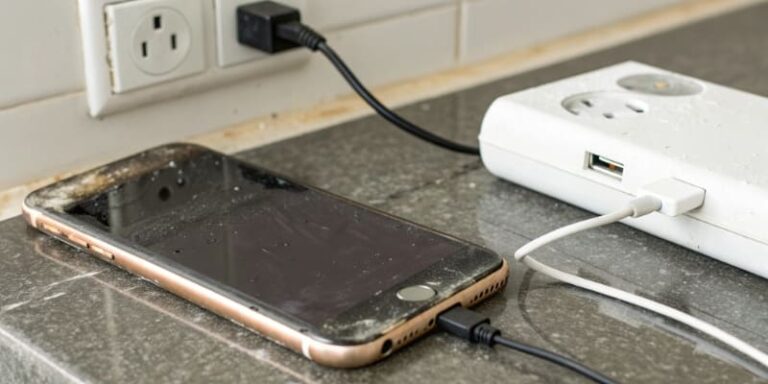
Your electronic device accidentally got wet. You worry about the device, but the real danger might be the lithium battery inside. What happens when these two meet?
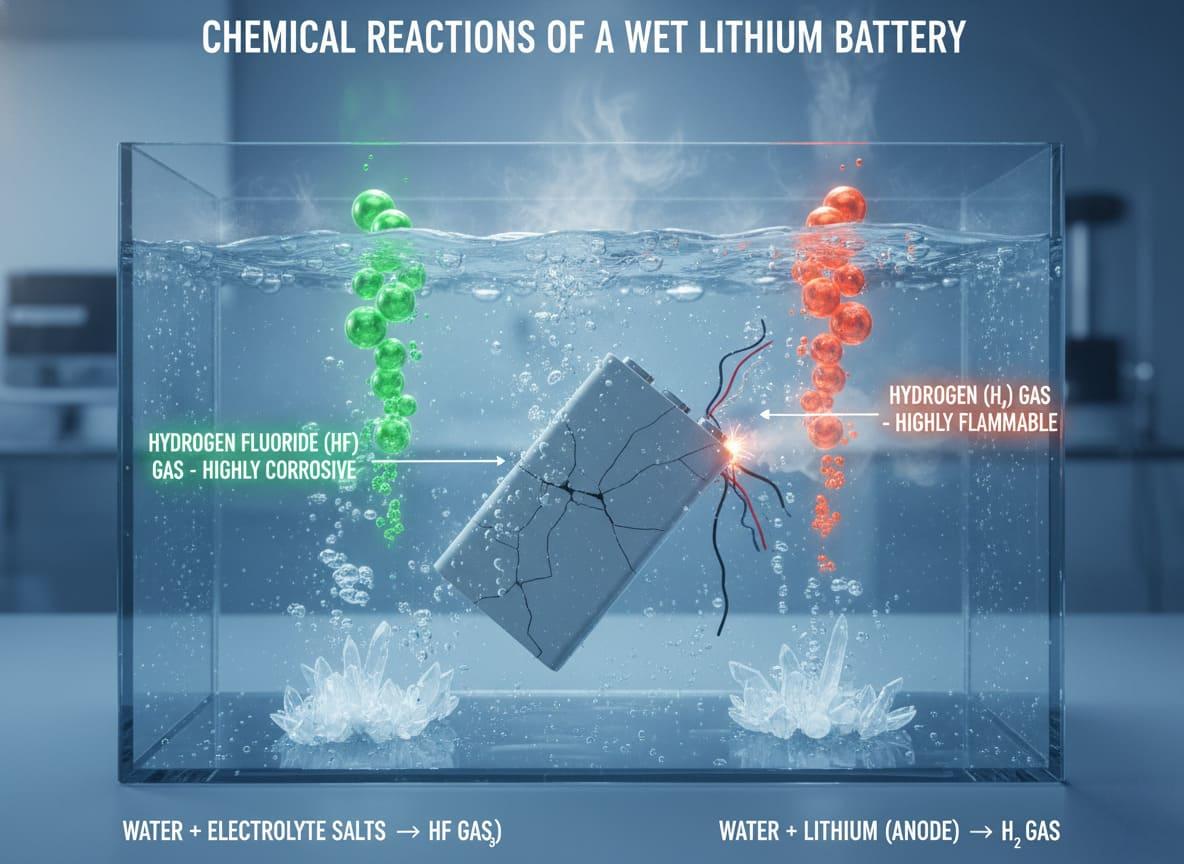
When a lithium battery contacts water, a series of chemical reactions begins. Water reacts with the electrolyte salts, like LiPF₆, to produce highly corrosive hydrogen fluoride (HF) gas. It also reacts with the lithium in the anode to create flammable hydrogen (H₂) gas.
I’ve been in the battery business for a long time, and I’ve seen many product failures. Often, the cause is something simple, like a seal failing and letting moisture in. A tiny bit of water can start a big problem. Many of our clients, especially in the medical and wearable device fields, ask about this. They need to know the risks to design better, safer products. Let's break down exactly what happens, so you can understand the science and protect your devices and users. This knowledge is key to building reliable products.
How dangerous are the hydrogen and hydrogen fluoride gases produced?
You see bubbles coming from a wet battery. It's easy to dismiss it as just air. But these gases are a serious hazard you need to understand.
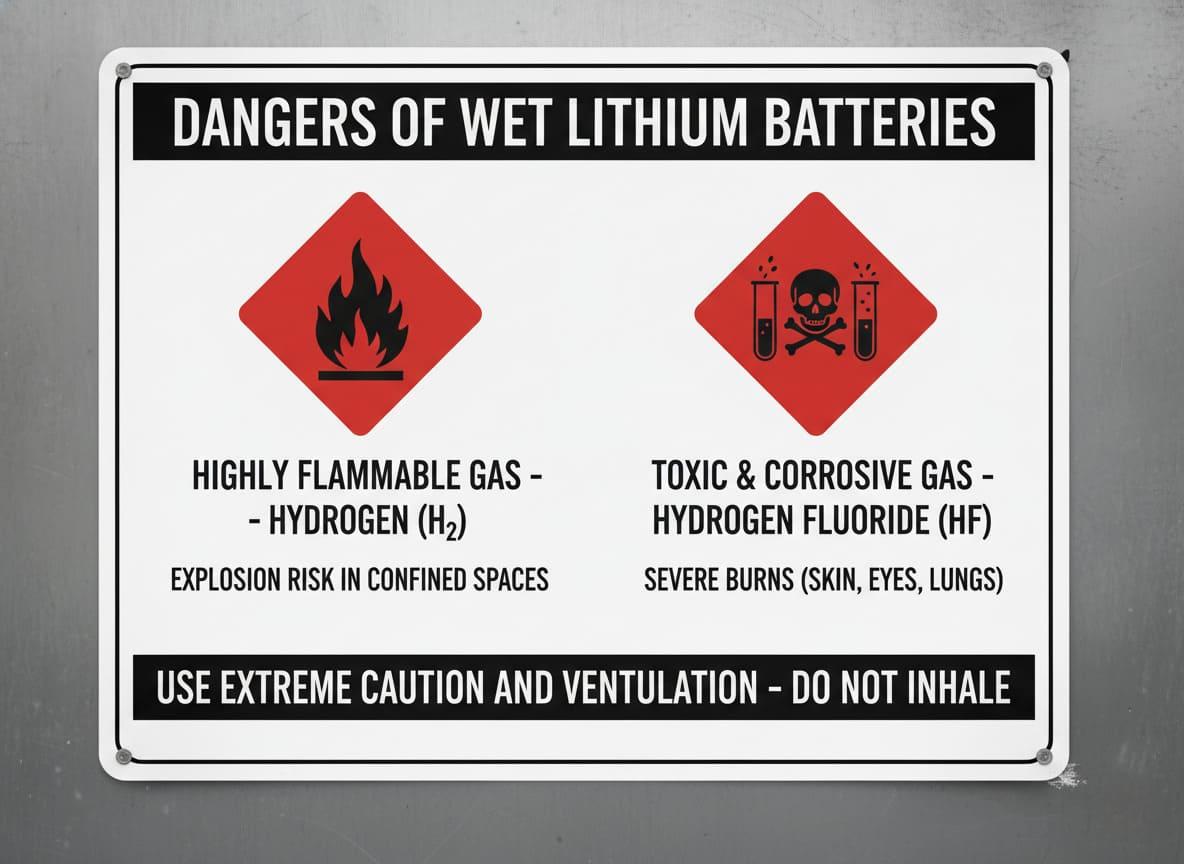
The gases released are extremely dangerous. Hydrogen (H₂) is highly flammable and can cause an explosion in a confined space. Hydrogen fluoride (HF) is a toxic and corrosive gas that can cause severe burns to the skin, eyes, and lungs upon contact or inhalation.
Let's look at these two gases more closely. It’s important to understand them separately because they present different types of risks. One is about fire, and the other is about health.
When water enters the battery, it can react directly with the charged lithium metal at the anode. This reaction, 2Li + 2H₂O → 2LiOH + H₂↑, produces hydrogen gas (H₂). The main problem with hydrogen is its flammability. It has a very wide explosive range in air, meaning even a small amount can ignite with just a tiny spark. If the battery is inside a sealed device casing, this gas can build up. The pressure increases, which can make the device swell or even burst. If a spark occurs, from a short circuit for example, you have a potential explosion.
The other gas, hydrogen fluoride (HF), is even more insidious. It forms when water reacts with the common electrolyte salt, lithium hexafluorophosphate (LiPF₆). This reaction breaks down the salt and creates HF. Unlike hydrogen, HF is not flammable. Its danger is its extreme toxicity and corrosiveness. If you inhale it, it can cause severe damage to your lungs. If it touches your skin, it can cause deep, painful burns that may not be immediately obvious. It also attacks glass and metal, meaning it corrodes the internal components of the battery, making the situation even worse.
Here is a simple table to compare the two:
| Feature | Hydrogen (H₂) | Hydrogen Fluoride (HF) |
|---|---|---|
| Primary Hazard | Flammability, Explosion | Toxicity, Corrosiveness |
| How It's Formed | Water reacts with lithium metal | Water reacts with electrolyte salt |
| Physical Sign | Bubbles, Swelling | Acrid smell, Corrosion of components |
| Safety Precaution | Ventilate area, avoid sparks | Avoid contact, wear protective gear |
At Litop, when we design custom batteries for our clients' products, we always consider the risk of moisture. Proper sealing and enclosure design are the first line of defense against these dangerous reactions.
How do freshwater and saltwater reactions differ in speed and danger?
Your product might be used near a pool or at the beach. You might think water is water, but the type of water makes a huge difference in the outcome.
Saltwater causes much faster and more dangerous reactions. Its high conductivity creates immediate, severe short circuits, generating heat rapidly. Freshwater is less conductive, so the short-circuiting process is slower, though the chemical reactions still occur and remain a significant risk.
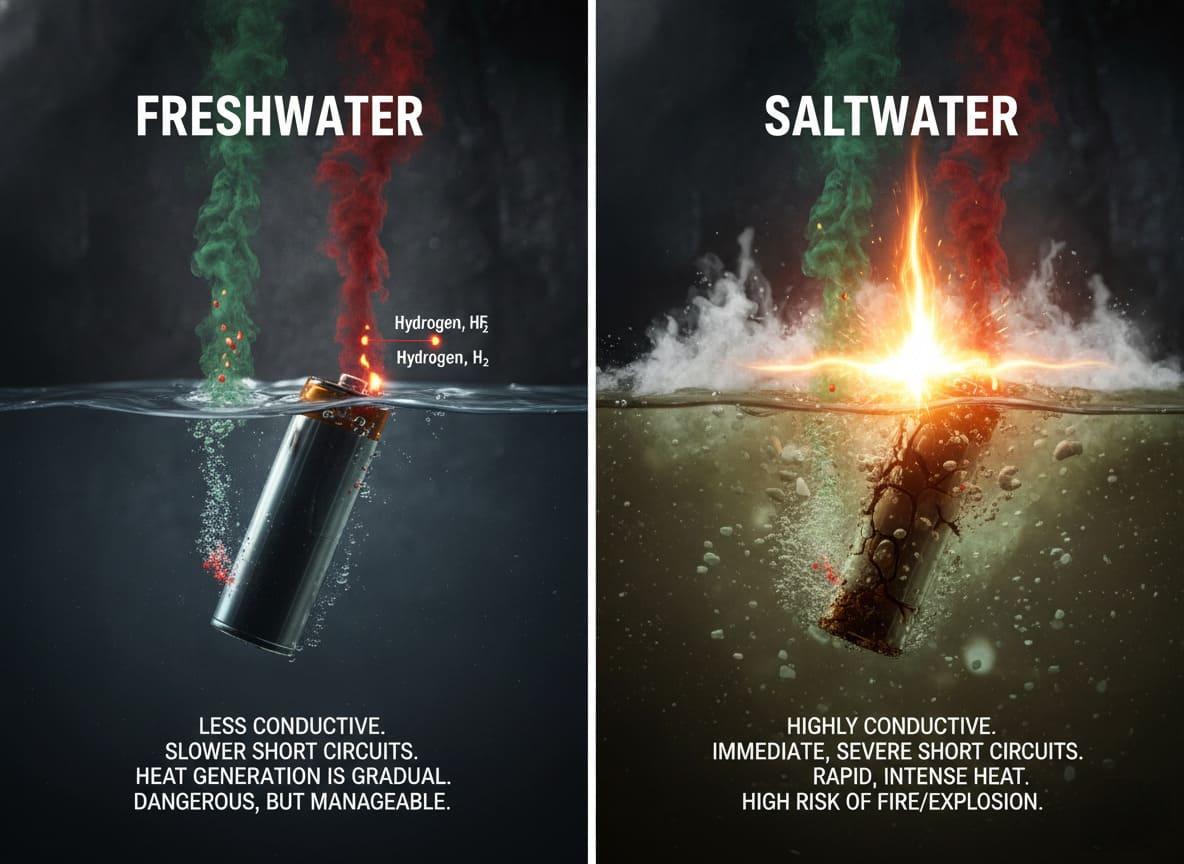
The key difference between saltwater and freshwater is conductivity. Think of it like a road for electricity. Freshwater is like a small country lane; electricity can travel, but it's slow and difficult. Saltwater, full of dissolved ions like sodium and chloride, is like a multi-lane superhighway. Electricity flows through it very easily.
When water gets inside a battery, it can create a bridge between the positive and negative terminals. This is a short circuit. In freshwater, the short circuit is weak because the water itself doesn't conduct electricity very well. The battery will discharge, but it might happen slowly over several hours. This slow discharge still generates heat and the dangerous gases we discussed, but the process is less violent.
In saltwater, the story is completely different. The highly conductive saltwater creates a very strong and immediate short circuit. A large amount of current flows instantly, which generates a lot of heat very quickly. This rapid heating can accelerate the other chemical reactions, producing hydrogen and hydrogen fluoride gas much faster. The combination of intense heat and rapid gas production dramatically increases the risk of the battery swelling, bursting, or even catching fire.
Here’s a comparison to make it clearer:
| Factor | Freshwater Exposure | Saltwater Exposure |
|---|---|---|
| Conductivity | Low | Very High |
| Short Circuit | Slow, less intense | Rapid, intense |
| Heat Generation | Gradual | Fast and significant |
| Gas Production | Slower rate | Very rapid rate |
| Overall Risk | High risk of damage, gas release over time | Extreme risk of rapid fire, explosion, and gas release |
When I work with companies making marine electronics or devices for coastal use, this is a critical point. We must design battery packs with superior waterproofing and corrosion-resistant connections. Assuming a device will only ever encounter freshwater is a dangerous mistake that can lead to catastrophic failure in the field.
How do you safely handle and dispose of a water-damaged lithium battery?
You've found a device with a wet, possibly swollen battery. Your first instinct might be to just throw it away. This is the most dangerous thing you can do.
Immediately move the battery to a safe, isolated, and well-ventilated area away from flammable materials. Place it in a fireproof container, like a metal can with sand. Do not attempt to charge or use it. Contact a professional e-waste or hazardous waste disposal service.
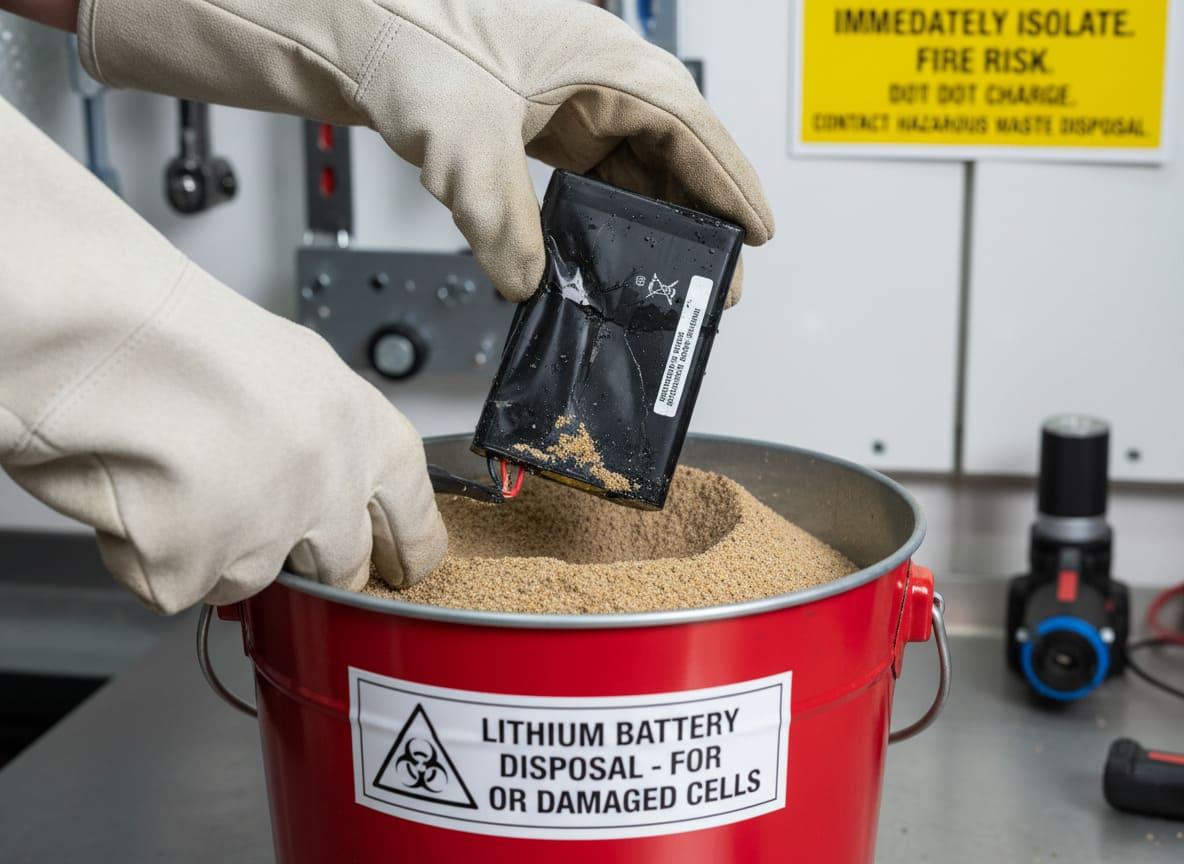
Dealing with a water-damaged battery requires a careful, step-by-step approach. Safety is the absolute priority. I've heard stories from clients who mishandled these situations and were lucky to avoid a fire. Here is the process you should always follow.
First, protect yourself. Put on safety glasses and gloves, preferably made of a chemical-resistant material. The battery might be leaking corrosive electrolyte, and you want to avoid any contact with your skin.
Second, assess the battery. Is it swelling, hissing, or getting hot? If so, the situation is urgent. Do not touch it if it's hot. Your goal is to move it to a safe location. This means a place outdoors, on a non-combustible surface like concrete, and far away from anything that could catch fire. A well-ventilated area is crucial to prevent the buildup of flammable hydrogen gas.
Third, find a safe container. The best option is a fireproof container. A metal bucket or can filled with sand is an excellent choice. The sand helps to absorb any leaking electrolyte and can smother a potential fire. Carefully place the battery in the sand. Do not use water to extinguish a lithium battery fire; it will only make the chemical reaction worse. A Class D fire extinguisher is required for lithium metal fires.
Fourth, and this is very important: do not try to use, test, or charge the battery. A damaged battery is unstable. Trying to draw power from it or push power into it can trigger a violent reaction.
Finally, you must dispose of it correctly. Lithium batteries cannot go in your regular trash. They are considered hazardous waste. You need to find a local e-waste collection site or a hazardous waste facility that accepts them. Call them beforehand and explain the situation—that you have a water-damaged lithium battery. They will give you specific instructions on how to transport it to them safely.
Under what conditions do these reactions lead to thermal runaway or explosion?
A wet battery is dangerous, but what is the tipping point? What pushes it from a slow, fizzing reaction into a full-blown fire or explosion?
Thermal runaway occurs when a short circuit, caused by water, generates more heat than the battery can dissipate. This heat triggers further chemical reactions that release more heat and flammable gas. This vicious cycle escalates rapidly, leading to fire and explosion, especially in fully charged batteries.
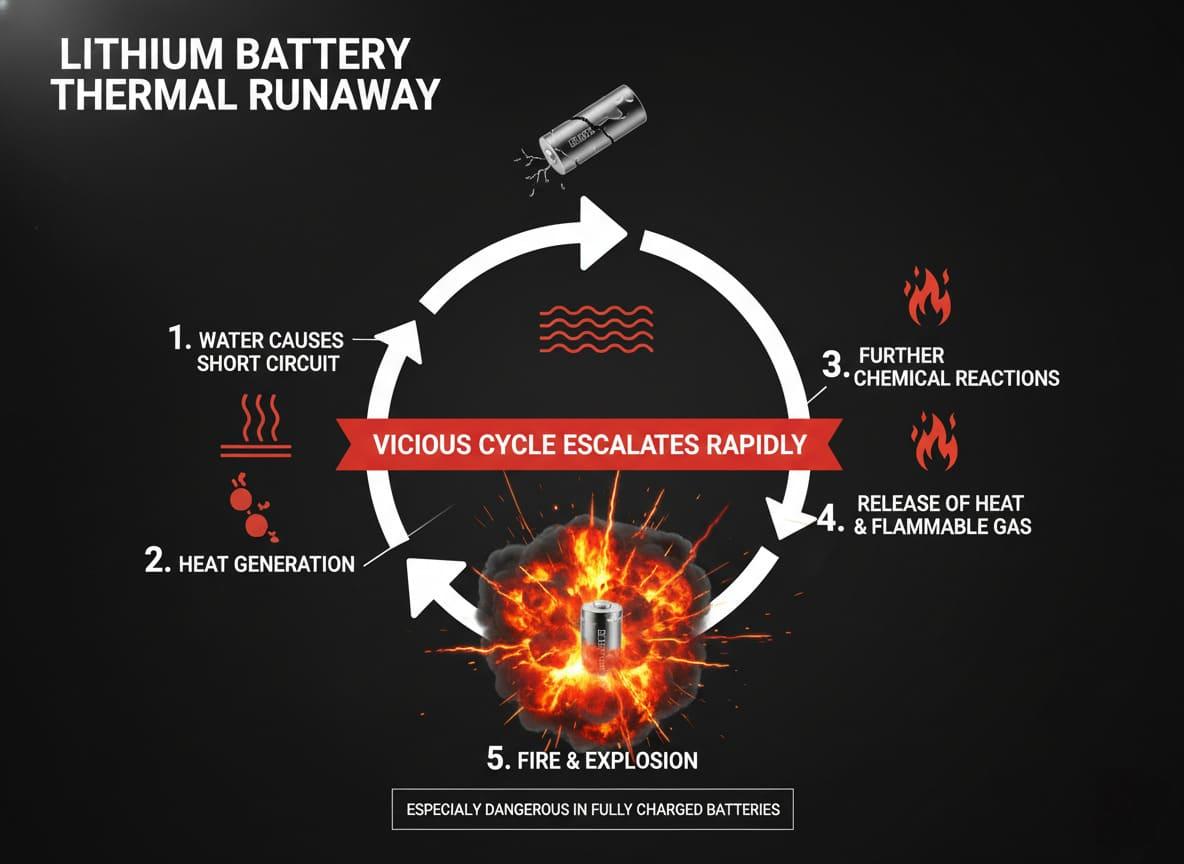
Thermal runaway is the ultimate failure mode for a lithium battery. It's a chain reaction that feeds itself, and once it starts, it's very difficult to stop. Water is a very effective trigger for this process. Let's break down the conditions that lead to this worst-case scenario.
The first condition is the severity of the short circuit. As we discussed, highly conductive saltwater will create a much more intense short circuit than freshwater. This generates a large amount of heat very quickly, which is the initial push that starts the thermal runaway process. The internal temperature of the battery begins to rise.
The second critical condition is the battery's State of Charge (SoC). A fully charged battery contains a huge amount of stored energy. It's like a tightly wound spring, ready to release. A depleted battery has much less energy to give. When a fully charged battery shorts out, all that energy is released as heat, making thermal runaway far more likely and much more violent. This is why we ship our batteries at a partial charge, usually around 30-50% SoC, as it's a much safer state for transport.
The third condition is heat dissipation. If the battery is in a tightly sealed, insulated enclosure, the heat it generates has nowhere to go. The temperature inside the battery and the device will climb rapidly. Around 130-150°C (265-300°F), the separator, a thin plastic film that keeps the anode and cathode from touching, begins to melt. Once the separator fails, a massive internal short circuit occurs, and the reaction becomes uncontrollable. The battery releases its remaining energy almost instantly, along with flammable gases, resulting in fire, an explosion, or both.
At Litop, our Battery Management Systems (BMS) are designed with protections like over-current and over-temperature sensors. While a BMS can't stop an external short caused by water, it's a vital part of a multi-layered safety strategy to prevent the conditions that lead to thermal runaway in normal operation.
Conclusion
Understanding what happens when lithium batteries and water mix is not just an academic exercise. It is essential for safety and for designing reliable products. Water triggers dangerous chemical reactions that produce flammable and toxic gases, and a severe short circuit can lead to a catastrophic thermal runaway.