Worried about your boat or RV battery failing in wet conditions? Power loss can ruin trips. Standard batteries can't handle water, leading to costly damage and leaving you stranded.
The best waterproof lithium batteries for 2025 are robust LiFePO4 models, like our Litop M-series. They offer high IP ratings (IP67 or higher), advanced BMS protection, and stable power. Key features include high-precision SOC monitoring and low self-discharge, ensuring reliability for marine and recreational vehicle use.

Choosing the right battery is a big decision. It's about more than just finding something labeled "waterproof." I've spoken with many clients, like Michael, a business owner who needs absolute reliability for his products. He can't afford failure, and neither can you on the open water or a remote campsite. The details really matter when you're making an investment in your power system. A good battery provides freedom and peace of mind. A bad one just causes headaches. So, let's break down what you really need to look for to make a smart choice.
Is an IP67 rating safe enough for boats and RVs, or is IP68 essential?
Confused by IP ratings? Choosing the wrong one can lead to water damage and battery failure. An under-protected battery is a major risk, especially when exposed to waves or heavy rain.
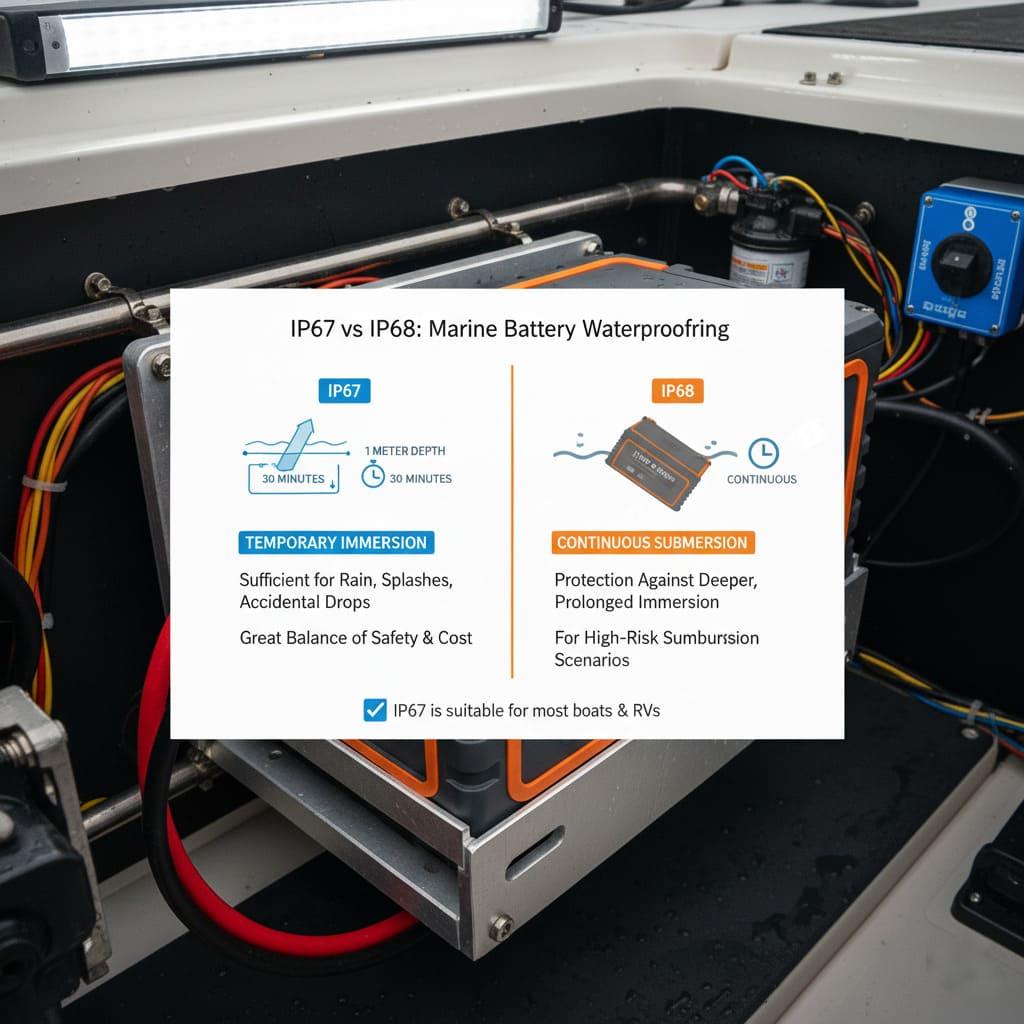
IP67 is generally sufficient for most boat and RV applications, protecting against temporary immersion up to 1 meter for 30 minutes. IP68 offers protection against continuous, deeper immersion. For most users, IP67 provides a great balance of safety and cost, unless submersion is a frequent risk.
Let's make IP ratings simple. The letters "IP" stand for Ingress Protection. It's a standard that tells you how well a device is sealed against dust and water. The first number is for solids, like dust, and the second number is for liquids. A "6" for the first number, as in IP67, means the unit is completely dust-tight. That's the highest rating for dust protection.
The second number is what we care about for a waterproof battery. A "7" means the battery can be submerged in water up to 1 meter deep for 30 minutes without any water getting inside. This is more than enough for most situations you'll face on a boat or in an RV. It easily handles heavy rain, big waves splashing over the side, or even if you accidentally drop it in shallow water. For about 95% of users, IP67 is the perfect level of protection.
An IP68 rating means the battery can handle continuous submersion deeper than 1 meter. The manufacturer has to specify the exact depth and time. This is for equipment that lives underwater, like a bilge pump. For your main house battery, it's usually overkill and costs more. The most important thing is not just the number, but that the manufacturer has actually tested and certified the rating. At Litop, we put our M-series batteries through tough testing to guarantee they meet their IP67 rating, so you know the protection is real.
| Feature | IP67 | IP68 |
|---|---|---|
| Protection Against | Temporary Immersion | Continuous Immersion |
| Depth | Up to 1 meter | Deeper than 1 meter |
| Duration | Up to 30 minutes | Specified by Manufacturer |
| Common Use Case | Most RVs, deck-mounted boat batteries | Submersible equipment, bilge pumps |
Beyond IP rating, what key specs should I check to meet my needs?
Are you overwhelmed by technical jargon like Ah, BMS, and CCA? It is hard to know what really matters. Choosing based on the wrong specs means you could end up with a battery that can't power your gear.
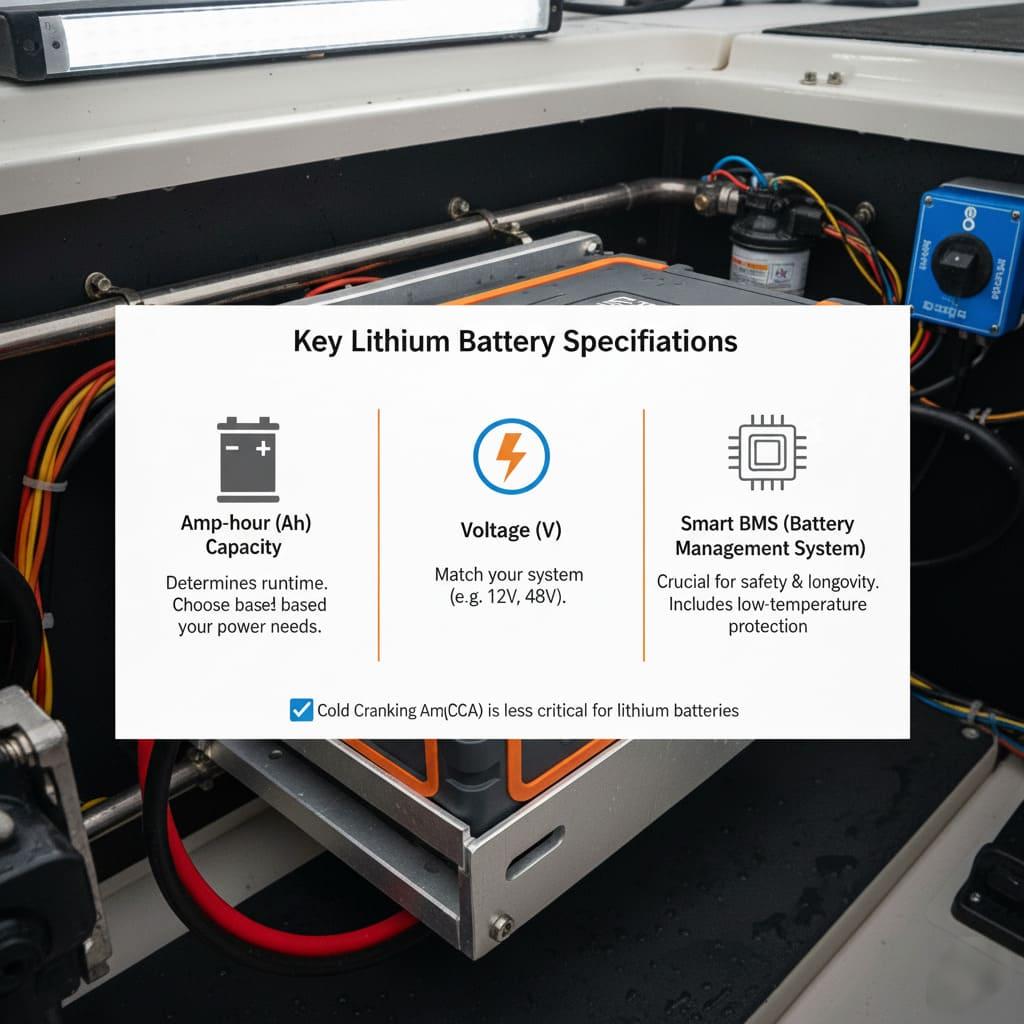
Focus on Amp-hour (Ah) capacity for runtime, voltage (12V/48V) to match your system, and a smart Battery Management System (BMS) for safety. For lithium, Cold Cranking Amps (CCA) is less critical than a BMS with low-temperature protection, which is far more important.
When I talk to new customers, I always tell them to ignore most of the marketing hype and focus on four things. These are the specs that determine if a battery will actually work for you.
First is Amp-hour (Ah) capacity. Think of this as your fuel tank. It tells you how long the battery can power everything. You need to calculate your daily energy use to choose the right size. Add up the power draw of your lights, refrigerator, navigation tools, and everything else.
Second is Voltage. Most boats and RVs use a 12V system. It's the standard. But some larger, more complex systems are moving to 48V for better efficiency over long wires. Our Litop M-series comes in both M12 (12V) and M48 (48V) versions to match whatever system you have.
Third, and most important, is the Battery Management System (BMS). This is the battery's brain. It protects the expensive lithium cells inside from damage. It prevents over-charging, over-discharging, high temperatures, and short circuits. A cheap battery often has a cheap BMS, and that’s a huge risk. Our M-series has an advanced BMS with high-precision SHUNT current detection. This gives you a very accurate State of Charge (SOC), like a reliable fuel gauge, so you're never guessing how much power is left.
Finally, let's talk about Cold Cranking Amps (CCA). This is an old term for lead-acid starting batteries. For a lithium "house" battery that runs your electronics, CCA doesn't matter. What matters is a BMS with low-temperature charge protection. You can permanently damage a lithium battery by charging it when it's below freezing (0°C or 32°F). A smart BMS will automatically stop charging in the cold to protect your investment.
| Specification | What It Means | Why It Matters for Boats/RVs |
|---|---|---|
| Amp-hour (Ah) | Energy storage capacity | Determines how long you can power your devices. |
| Voltage (V) | Electrical system compatibility | Must match your boat/RV's system (e.g., 12V, 48V). |
| BMS Features | Internal protection/management | Ensures safety, longevity, and accurate SOC data. |
| Low-Temp Protection | Prevents charging below 0°C | Protects the battery from permanent damage. |
What upgrades do my boat or RV's electrical system need for these lithium batteries?
Thinking of switching to lithium? Your old charging system might not be compatible. Using the wrong charger can damage expensive lithium batteries and even create a safety risk.
You will likely need to upgrade your converter/charger to one with a specific lithium (LiFePO4) charging profile. Your solar charge controller and any battery-to-battery chargers should also be lithium-compatible. This ensures proper charging and maximizes battery life without causing damage.
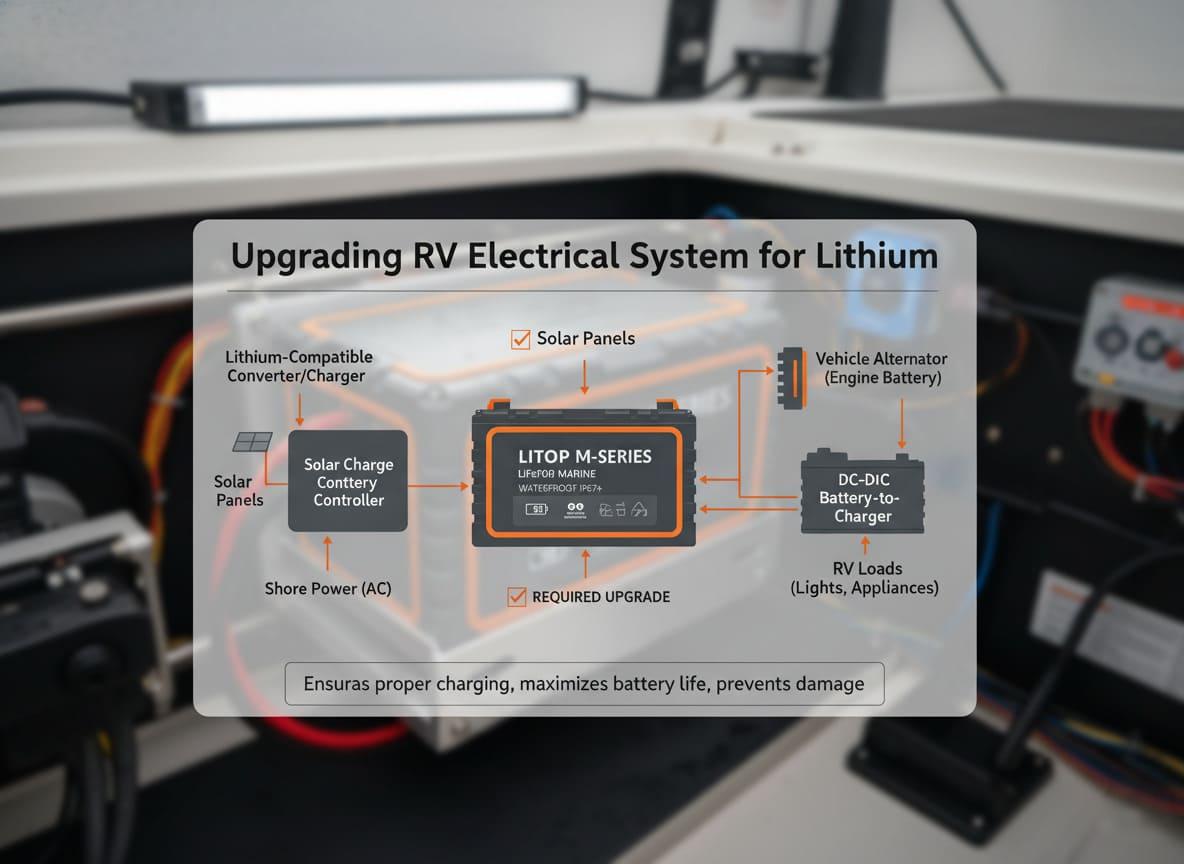
Dropping in a lithium battery isn't always a simple swap. Your vehicle's electrical system was probably designed for old lead-acid batteries, and lithium batteries have very different needs. I always advise my clients to check their charging system to protect their new battery investment.
The first thing to look at is your main converter or battery charger. A lead-acid charger uses voltages and charging stages that are wrong for lithium. It can fail to fully charge your LiFePO4 battery, or worse, hold the voltage too high for too long, which degrades the cells. You need a charger that has a specific lithium or LiFePO4 setting. This provides the correct charging profile to keep your battery healthy.
Next, if you have solar panels, your solar charge controller also needs to be lithium-compatible. Just like the main charger, it needs to deliver the right voltage to safely charge the battery from the sun. Most modern solar controllers have this setting.
If you charge your batteries from your engine's alternator, this is a critical point. The alternator is designed for lead-acid batteries. Connecting it directly to a large lithium battery bank can overload and destroy the alternator. The solution is a DC-to-DC charger. This device sits between the alternator and your lithium batteries. It protects your alternator and provides a perfect, multi-stage charge to the lithium bank while you drive or motor. It's a necessary component for any serious system. These upgrades are a one-time cost, but they ensure your new, high-performance batteries last for a decade or more, giving you the reliable power you paid for.
How do I maintain waterproof batteries in harsh marine environments to maximize their lifespan?
Saltwater and extreme temperatures are tough on equipment. How can you protect your battery investment? Neglecting maintenance can lead to corrosion and premature failure, even with a waterproof battery.
To maximize lifespan, keep terminals clean from salt corrosion using a brush and corrosion inhibitor spray. Ensure connections are tight. While the battery is waterproof, regularly rinse the exterior with fresh water. Use a smart BMS to monitor cell health and avoid deep discharges.

A waterproof case is a great start, but it doesn't make a battery invincible, especially in a saltwater environment. I've seen perfectly sealed batteries fail because the external connections were ignored. A little bit of easy maintenance goes a long way.
The number one enemy is corrosion on the battery terminals. Salt spray is everywhere in a marine environment, and it loves to attack metal. This corrosion creates resistance, which leads to voltage drop and heat. Eventually, your connection can fail completely. Every month or so, inspect the terminals. If you see any white or greenish powder, disconnect them and clean them with a wire brush. Once they are clean and re-tightened, protect them with a layer of dielectric grease or a marine-grade corrosion inhibitor spray. This creates a barrier that keeps the salt and moisture out.
Also, even though the battery case is waterproof, it's good practice to rinse it with fresh water after you've been out on the ocean. This washes away the salt crystals that build up on the outside, which helps protect the terminals and any other hardware.
Finally, think about storage. This is where many batteries die. If you're putting your boat or RV away for the winter, you shouldn't leave the battery at 100% or 0% charge. The ideal storage level is around 50-60%. A huge benefit of our Litop M-series is the independent battery switch. You can turn it completely off, so the power consumption drops to zero. This, combined with its ultra-low self-discharge rate, means you can store it for months without worrying about it going flat and getting damaged. It completely prevents the over-discharge that kills so many other batteries during the off-season.
Conclusion
Choosing the right waterproof lithium battery means looking beyond the label. Focus on a certified IP rating, a smart BMS, and the right capacity. Proper installation and simple maintenance will ensure your Litop battery provides reliable power for all your adventures for years to come.