
Your device suddenly shuts down, leaving you with a dead product. This unreliability is frustrating and can damage your brand's reputation. Learning to spot a failing battery early is key.
The clearest signs of a bad lithium battery are physical damage like swelling or leaking, a rapid loss of charge, or a complete failure to recharge. You can also use a multimeter to check if the voltage is significantly below its rated level, confirming it's bad.

I've been in the battery business for a long time, and one thing I hear constantly from new clients is frustration. They've been burned by suppliers whose batteries fail prematurely. I remember one client, a medical device developer from the US, who was facing a product recall because batteries were dying in the field after just a few months. He thought he was saving money, but the cost to his reputation and the expense of replacements were enormous. He learned the hard way that not all batteries are created equal, and knowing how to identify a problem is the first step.
But how do you really know if the issue is the battery itself? It's not always as obvious as a swollen case. Let's dig deeper into the signs and what you can do about them.
How do I tell if my lithium battery is bad?
You suspect a battery is failing, but you're not sure. This uncertainty can halt production or lead to faulty products reaching your customers, causing major headaches and potential costs.
Look for the three main indicators: visual, performance, and electrical. Visually inspect for swelling, cracks, or leaks. In terms of performance, notice if it drains too quickly or won't charge fully. Electrically, a multimeter reading well below the nominal voltage is a sure sign of a problem.
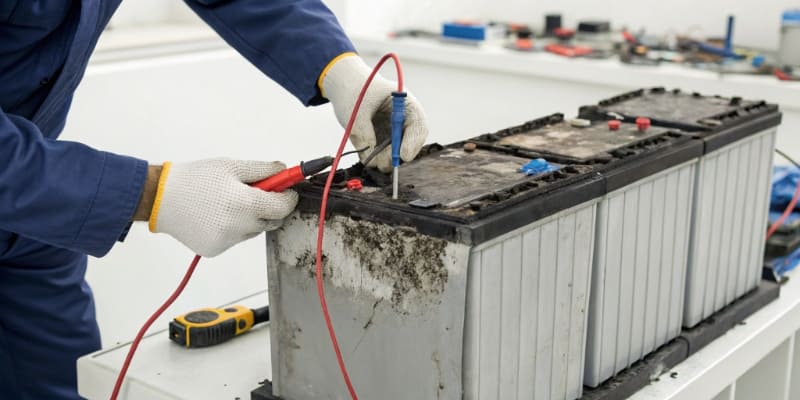
When a customer comes to us at Litop with a battery problem, we usually walk them through a simple diagnostic process. It's about looking for clear, undeniable evidence. You don't need to be a battery engineer to spot the most common issues, but you do need to be systematic. We break it down into three areas.
1. Visual Inspection
This is your first line of defense. A healthy battery should look pristine. Any change to its physical shape is a red flag.
- Swelling or Bulging: This is the most dangerous sign. It's caused by gas buildup inside the cell, a process called outgassing. It means the internal structure has failed, and the battery is a fire risk. If you see this, stop using it immediately.
- Cracks or Dents: The casing protects the delicate internals. Any physical damage can compromise the separators between the anode and cathode, leading to a short circuit.
- Corrosion or Leaks: Look for any residue around the terminals or seams. This indicates the electrolyte is leaking, which is both a performance and safety issue.
2. Performance Degradation
This is how the battery behaves during use. A bad battery simply won't perform like a new one.
- Reduced Capacity: The most common symptom. If a device that used to last ten hours now only lasts three, the battery can no longer hold a full charge.
- Failure to Charge: It either won't start charging at all, or it stops before reaching 100%.
- Overheating: It's normal for batteries to get slightly warm during charging or heavy use. But if it becomes too hot to touch, something is wrong internally.
3. Basic Electrical Checks
If the battery passes the visual and performance checks but you're still suspicious, a simple electrical test can give you a definitive answer. Using a multimeter set to DC voltage, you can measure the battery's output. A healthy, fully charged lithium-ion cell should be around 4.2 volts, while a LiFePO4 cell will be around 3.6 volts. If the reading is below 2.5 volts (for li-ion) or 2.0 volts (for LiFePO4), the battery is deeply discharged and likely permanently damaged.
| Symptom | What it Means | Action |
|---|---|---|
| Swelling/Bulging | Internal gas buildup, high risk of failure. | Immediately stop use and dispose of safely. |
| Fast Draining | Capacity has faded, end of life. | Replace the battery. |
| Low Voltage | Deeply discharged, likely permanent damage. | Replace the battery. |
| Overheating | Internal short or malfunction. | Immediately stop use. |
How do you bring a lithium-ion battery back to life?
You have a dead lithium battery, and replacing it is costly or inconvenient. You wonder if there's a way to revive it, a quick fix to get your device working again.
For a truly dead or damaged cell, you can't safely bring it back. However, if a battery is just deeply discharged and a good Battery Management System (BMS)1 has put it into "sleep mode" to protect it, you might be able to "wake it up" with a specialized charger.

I get asked this question a lot, and it's important to be very clear. Trying to "revive" a genuinely failed lithium battery—one that is swollen, leaking, or has an internally shorted cell—is extremely dangerous. You risk fire or explosion. In the professional world, especially for applications like medical or high-end consumer devices, the answer is always: don't do it. The risk to your product and end-user is not worth it.
However, there's a specific scenario where a battery might seem dead but isn't. This happens when a quality Battery Management System (BMS) does its job correctly.
The Role of the BMS in "Apparent" Failure
A BMS is the brain of a battery pack. One of its key jobs is to protect the cells from over-discharge. When the voltage of a cell drops below a safe threshold (e.g., 2.5V), the BMS will cut off the power output to prevent permanent damage. To the user and the device, the battery appears completely dead. It won't power anything.
In this state, some standard chargers may not recognize the battery because its voltage is too low. They are designed not to charge a battery that seems to be faulty, as a safety precaution.
"Waking Up" a Protected Battery
This is where the idea of "reviving" comes from. It's not about fixing a broken cell; it's about waking up a protected one.
- Use a Pre-charge Function: Many professional-grade chargers have a pre-charge or "wake-up" feature. They apply a very small, controlled current to the battery.
- Gentle Voltage Rise: This small current slowly raises the voltage of the cells. Once the voltage climbs back into the normal operating range, the BMS will "wake up" and turn the main power connection back on.
- Normal Charging Resumes: After the BMS is active again, the charger can switch to its normal charging cycle.
This process is only for batteries that have been over-discharged but are otherwise healthy. If you try this on a battery with a real internal fault, you could bypass safety features and cause a serious incident. That's why at Litop, we emphasize that for critical applications, any battery that has entered a deep discharge state should be professionally evaluated, not just "jump-started" and put back into service without inspection. The liability is just too high.
How can I test my lithium battery?
Your batteries seem fine, but you're worried about hidden problems. Simple voltage checks aren't enough, and you fear that batteries will fail months after you've shipped your product.
A basic test uses a multimeter for voltage. For a deeper analysis, you need a battery analyzer that measures capacity and internal resistance. However, the best method is relying on a sophisticated BMS that provides real-time State of Health (SOH)2 data, giving you the true story.
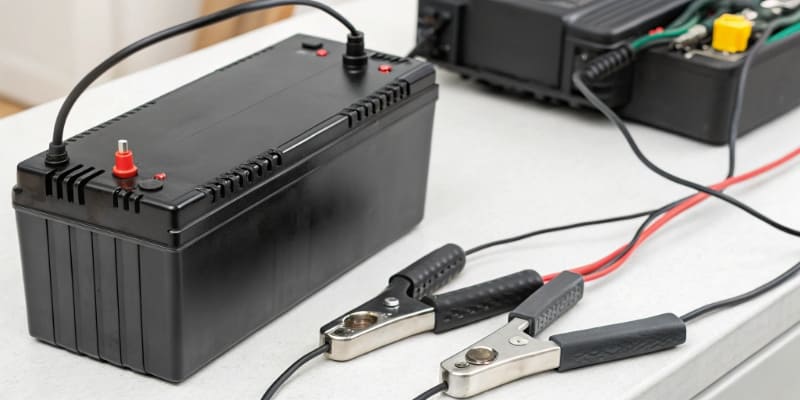
This is a pain point I see all the time. A client buys batteries that test perfectly for voltage and internal resistance. They look good. Six months later, their customers are complaining about poor performance. The problem is that many batteries "look normal" on the outside, but their internal health is already failing. This is where basic testing falls short.
In our R&D department at Litop, we go far beyond simple checks. True testing is about predicting future performance, not just measuring current status.
The Limits of Basic Testing
- Multimeter (Voltage): A voltage test only tells you the State of Charge (SOC) at that moment. It tells you if it's full or empty, but it says nothing about the battery's overall health or its ability to hold that charge in the future.
- Internal Resistance (IR) Meter: Measuring internal resistance gives a slightly better clue about health. As a battery ages, its IR increases. However, this value can fluctuate with temperature and SOC, so it's not a foolproof indicator on its own.
Professional Testing for Real Insight
To truly understand a battery's condition, you need to look at its State of Health (SOH). SOH is a measurement of a battery's condition relative to a new one. A battery with 80% SOH can only store 80% of its original design capacity. This is the metric that really matters for product lifetime.
There are two main ways to determine this:
- Full Cycle Test: This involves fully charging the battery, then fully discharging it under a controlled load while measuring the total energy delivered (in mAh or Wh). This gives you the true current capacity. It's accurate but slow and requires special equipment.
- Advanced BMS Algorithms: This is the modern, smart solution. A high-quality BMS, like the ones we design at Litop, constantly monitors the battery. It tracks voltage, current, temperature, and the number of cycles. Using sophisticated algorithms, it can accurately estimate the SOH in real-time without needing a full discharge test. This is the "health check" that prevents future failures.
Many manufacturers skimp on the BMS to save a few cents. They use basic protection circuits that only prevent explosions. They don't provide the data you need to ensure long-term reliability. We learned long ago that investing in a smarter BMS is the best way to guarantee performance and protect our clients' reputations. It’s the difference between selling a component and providing a reliable power solution.
What are the signs of a lithium battery failure?
You're worried about battery failures that could lead to safety incidents or product recalls. You know the obvious signs like swelling, but you wonder what other, less visible failures to watch for.
The classic signs are physical (swelling, leaks), performance-based (overheating3, not holding a charge), and electrical (zero voltage). A critical modern sign of failure is commercial: a battery lacking the required certifications or digital product passport for your target market is effectively a failed product.
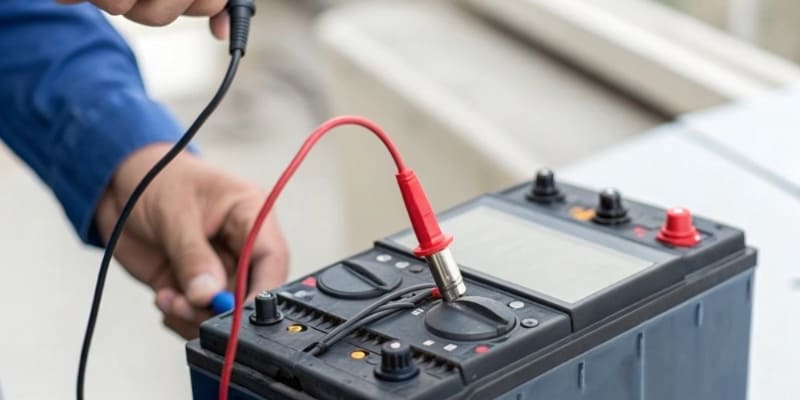
When we talk about battery failure, most people think of something dramatic, like a fire. And while safety is our number one priority, the definition of "failure" in today's global market is getting much broader. A battery can be a complete failure even if it works perfectly.
I was recently talking with a client in Germany about the new EU Battery Regulation. He was shocked to learn that in a few years, many of the batteries he currently uses will be illegal to sell in the EU. This brings us to a new type of failure: regulatory failure.
Traditional Signs of Failure
These are the well-known indicators that a battery is physically or electrically compromised.
- Thermal Runaway: This is the ultimate catastrophic failure. A chain reaction causes the battery's temperature to rise uncontrollably, often resulting in fire or explosion. It's typically preceded by swelling and significant overheating.
- Cell Imbalance: In a multi-cell pack, if one cell becomes weaker than the others, it will be over-discharged during use and over-charged during charging. A poor-quality BMS won't correct this, and the weak cell will eventually fail, bringing the whole pack down with it.
- Dendrite Growth: Over time, tiny, needle-like structures called dendrites can grow inside a lithium-ion battery. If they grow long enough to pierce the separator between the anode and cathode, they cause an internal short circuit, leading to rapid failure.
The New Sign of Failure: Non-Compliance
The business world is changing. Soon, especially in the EU, a battery's performance won't be the only thing that matters. It will also need an "identity"—a digital battery passport4.
- What is a Battery Passport? It's a digital record that provides detailed information about a battery's entire lifecycle. This includes the source of its raw materials, its carbon footprint during manufacturing, its capacity, health, and recycling information.
- Why it Matters: For any battery sold in the EU, this passport will be mandatory. If a battery doesn't have one, or if the data shows it doesn't meet sustainability and ethical sourcing standards, it will be barred from the market. It will be worthless, a "failed" product from a commercial standpoint.
This is a huge shift. As a manufacturer, we at Litop are already preparing for this. We are ensuring our supply chains are traceable and our production data is ready. Choosing a supplier who ignores these upcoming regulations is choosing a partner whose products are destined to fail in major markets. A battery without the right data is just as bad as a battery that won't hold a charge.
Conclusion
To tell if a lithium battery is bad, check for physical swelling, poor performance like rapid draining, and low voltage with a multimeter. For true reliability, partner with a supplier whose advanced BMS can predict a battery's health and who understands future compliance, like the EU Battery Passport.
Learn how a BMS protects your battery and enhances its lifespan. ↩
Measuring SOH is crucial for predicting battery performance and longevity. ↩
Understanding overheating can help you prevent dangerous situations with your devices. ↩
Learn about the digital battery passport and its implications for battery compliance. ↩