Dropped your device in water? You are probably worried if saltwater is worse than freshwater. You are right to be concerned, as the type of water makes a huge difference.
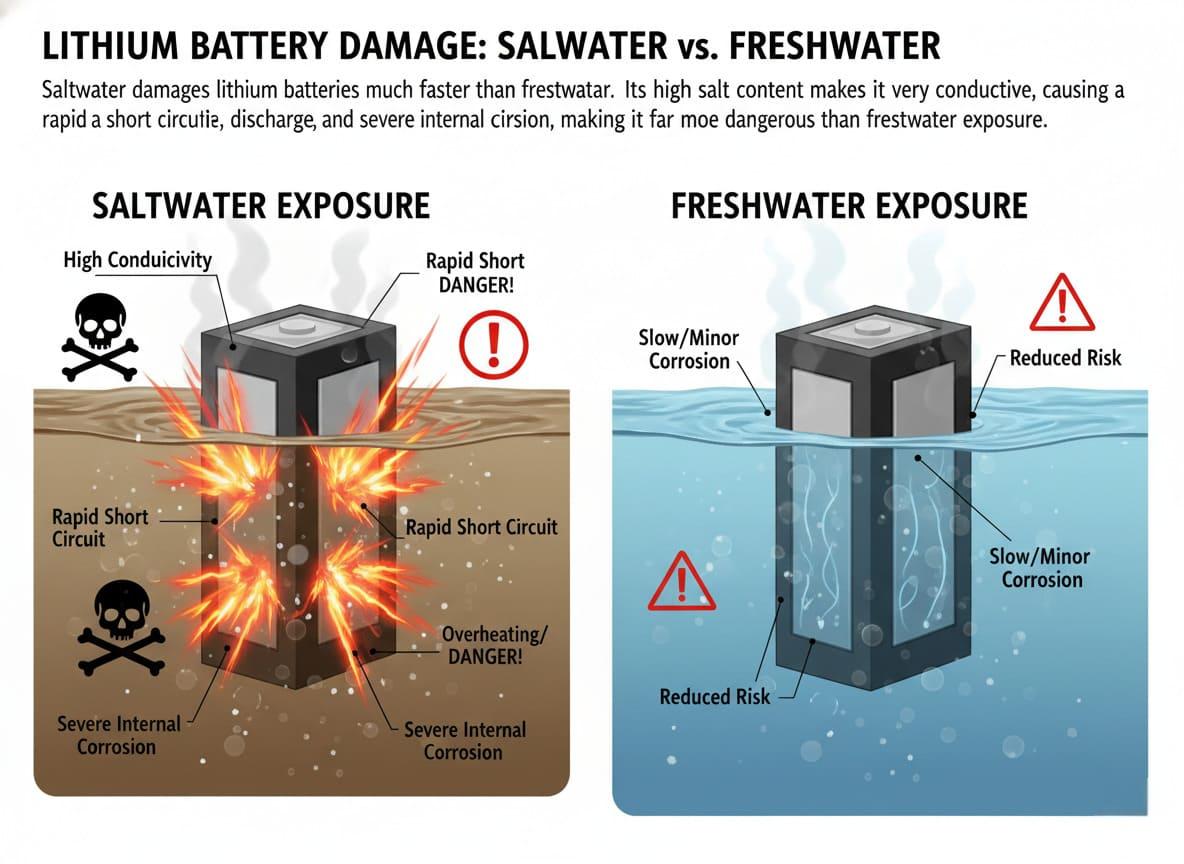
Yes, saltwater damages lithium batteries much faster than freshwater. Its high salt content makes it very conductive, causing a rapid short circuit. This leads to quick discharge, overheating, and severe internal corrosion, making it far more dangerous than freshwater exposure.
Seeing a device fall into water is always a sinking feeling. But knowing the difference between saltwater and freshwater exposure is crucial. It affects not just the battery's survival, but also your safety. Let's explore exactly what happens inside and how you should react.
How should I safely handle and dispose of a lithium battery exposed to saltwater?
Found a saltwater-soaked battery? It's not just broken; it's a hazard. Handling it wrong can be dangerous. You must follow a few simple steps to stay safe.
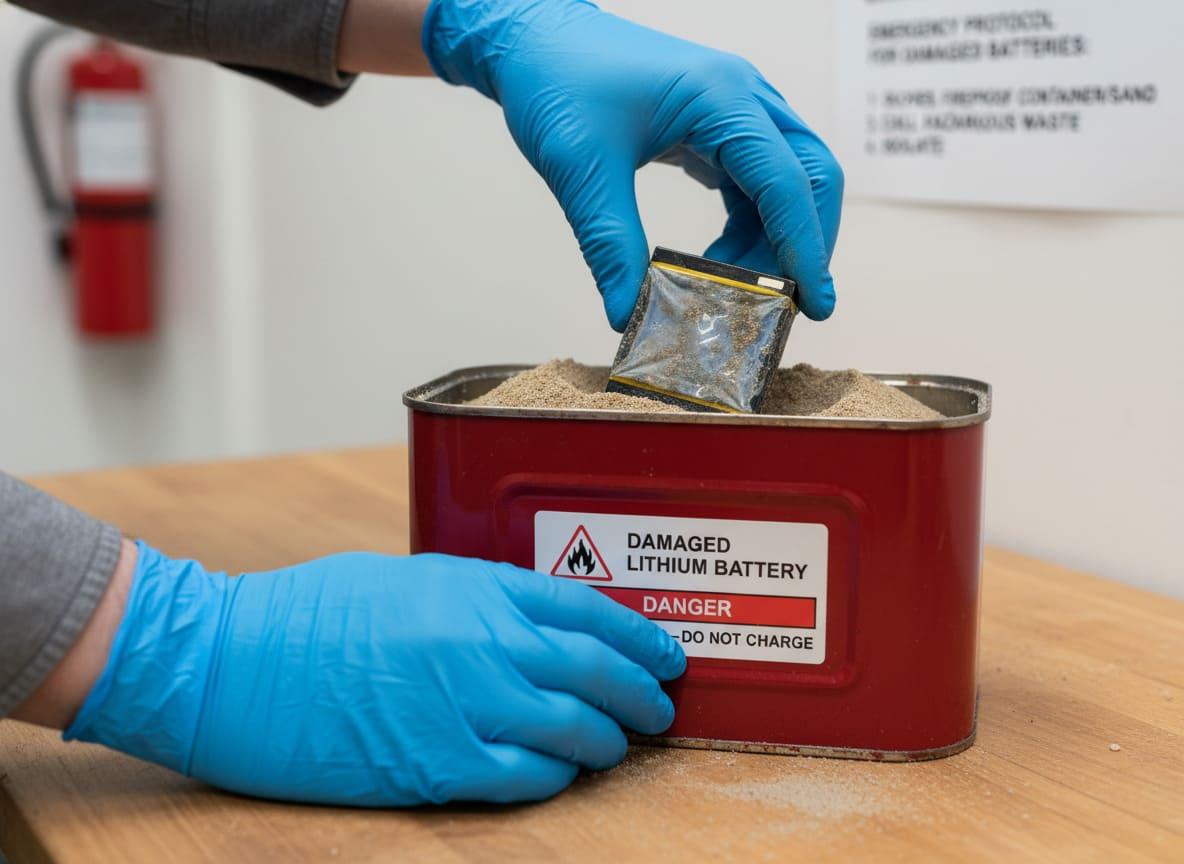
Immediately place the battery in a fireproof container, like a metal can with sand, away from flammable materials. Do not attempt to charge or use it. Contact your local hazardous waste disposal facility for proper recycling instructions, as it is considered dangerous goods.
When a lithium battery gets exposed to saltwater, your first thought should be safety, not salvage. As a battery manufacturer, I have seen the dangerous results of mishandling these situations. The combination of electricity and corrosive saltwater creates a volatile mix. You need a clear plan.
Step 1: Put Your Safety First
Before you even touch the battery, protect yourself. Wear insulated rubber gloves and safety glasses. A damaged battery can leak harmful chemicals that can irritate or burn your skin. You should never handle a compromised battery with your bare hands. The goal is to create a barrier between you and the potential hazard.
Step 2: Isolate the Battery Immediately
You must move the battery to a safe location. A short-circuiting battery can get very hot and catch fire. Place it in a fireproof container. A metal bucket with sand or dry dirt is a great option. The sand helps absorb any potential heat or energy release. Keep the container outdoors, away from your house, car, or anything that can burn.
Step 3: Do Not Try to Use or Charge It
This is the most important rule. Never, under any circumstances, try to charge or use a battery that has been in saltwater. Connecting it to a charger can trigger a violent reaction, including a fire or explosion. The internal components are already compromised, and adding more energy is like adding fuel to a fire.
Step 4: Find a Proper Disposal Location
You cannot throw a lithium battery in the regular trash. It is hazardous waste and can cause fires in garbage trucks and recycling facilities. You need to find a certified e-waste or battery recycling center. Search online for "battery recycling near me" or check with your local waste management authority. When you drop it off, be sure to tell the staff that the battery is damaged and was exposed to saltwater. They have special procedures for handling it safely.
| Action | Reason |
|---|---|
| DO wear gloves and glasses. | To protect from chemical leaks and shorts. |
| DO put it in a fireproof box. | To contain a potential fire. |
| DO take it to a hazardous waste facility. | For safe and legal disposal. |
| DON'T touch it with bare hands. | Risk of chemical burns and shock. |
| DON'T try to charge or use it. | High risk of fire and explosion. |
| DON'T throw it in the trash. | It is illegal and dangerous. |
What are the specific chemical differences in internal damage to a lithium battery caused by freshwater versus saltwater?
You know saltwater is worse, but do you know why? The internal chemistry tells the whole story. Understanding this difference helps you see the real danger inside the battery.
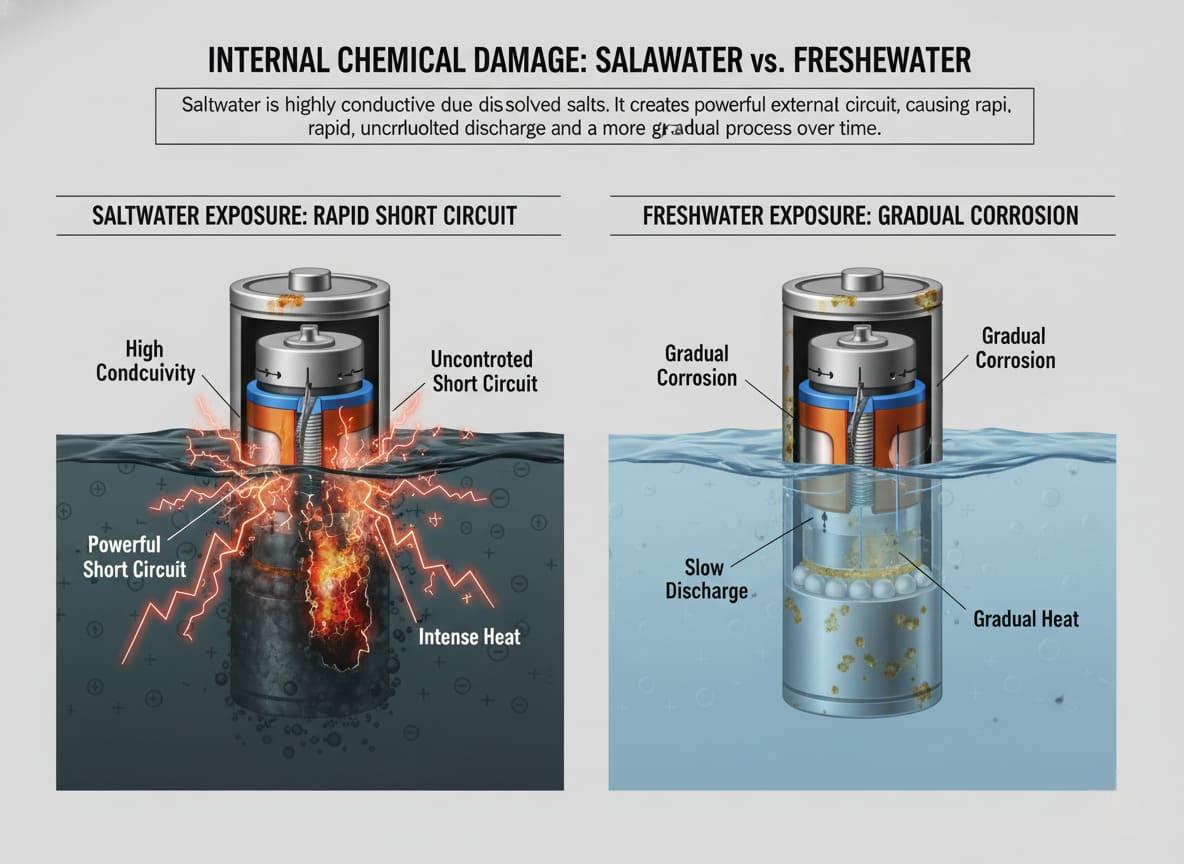
Saltwater is highly conductive due to dissolved salts. It creates a powerful external short circuit, causing rapid, uncontrolled discharge and intense heat. Freshwater has very low conductivity, leading to a much slower discharge and a more gradual corrosion process over time.
At Litop, we design batteries to be robust, but water intrusion is a major enemy, and not all water is the same. The chemical makeup of the water dictates the speed and type of destruction.
The Critical Role of Conductivity
The key difference is electrical conductivity. Pure water is a poor conductor of electricity. Freshwater and tap water have some impurities, so they conduct a little, but not much. Saltwater, on the other hand, is full of dissolved sodium chloride (NaCl). In water, this salt breaks apart into positive sodium ions (Na+) and negative chloride ions (Cl-). These free-floating ions make saltwater an excellent conductor, almost like a wire.
Saltwater's Fast and Aggressive Attack
When saltwater touches the battery's external positive and negative terminals, it creates a low-resistance path.
- Hard Short Circuit: This allows electricity to flow uncontrollably from one terminal to the other. This process is extremely fast and generates a lot of heat.
- Accelerated Corrosion: The chloride ions (Cl-) are extremely corrosive to the metals used in a battery, like copper and aluminum. This corrosion eats away at the battery's internal connections and casing much faster than simple rust (oxidation) from freshwater. This process damages the battery's structure and can release flammable materials.
Freshwater's Slow and Steady Damage
Freshwater causes damage too, but it's a much slower process.
- Slow Discharge: Because freshwater is a poor conductor, it does not create a strong short circuit. Any discharge that occurs is very slow and generates minimal heat. The immediate fire risk is much lower.
- Gradual Oxidation: The main damage from freshwater comes from long-term exposure. Water seeps into the battery and causes the metal components to rust and oxidize. This process slowly degrades the battery's performance and will eventually cause it to fail, but it happens over days or weeks, not minutes.
Here is a simple comparison:
| Feature | Saltwater Damage | Freshwater Damage |
|---|---|---|
| Speed | Very Fast (minutes to hours) | Slow (days to weeks) |
| Mechanism | Hard short circuit, rapid corrosion | Slow oxidation (rusting) |
| Heat Generation | High | Low to None |
| Immediate Risk | High risk of fire | Low immediate risk |
How can I tell if a saltwater-contaminated battery is completely damaged or if it can be “rescued”?
Your device got wet, and now you are hoping you can just dry out the battery and save it. But trying to "rescue" a saltwater-damaged battery is a gamble you should never take.
A saltwater-contaminated battery should always be considered permanently damaged and unsafe. Signs of failure include swelling, discoloration, corrosion on the terminals, or a burning smell. Do not attempt to dry it out or reuse it, as the internal damage is irreversible and poses a serious fire risk.
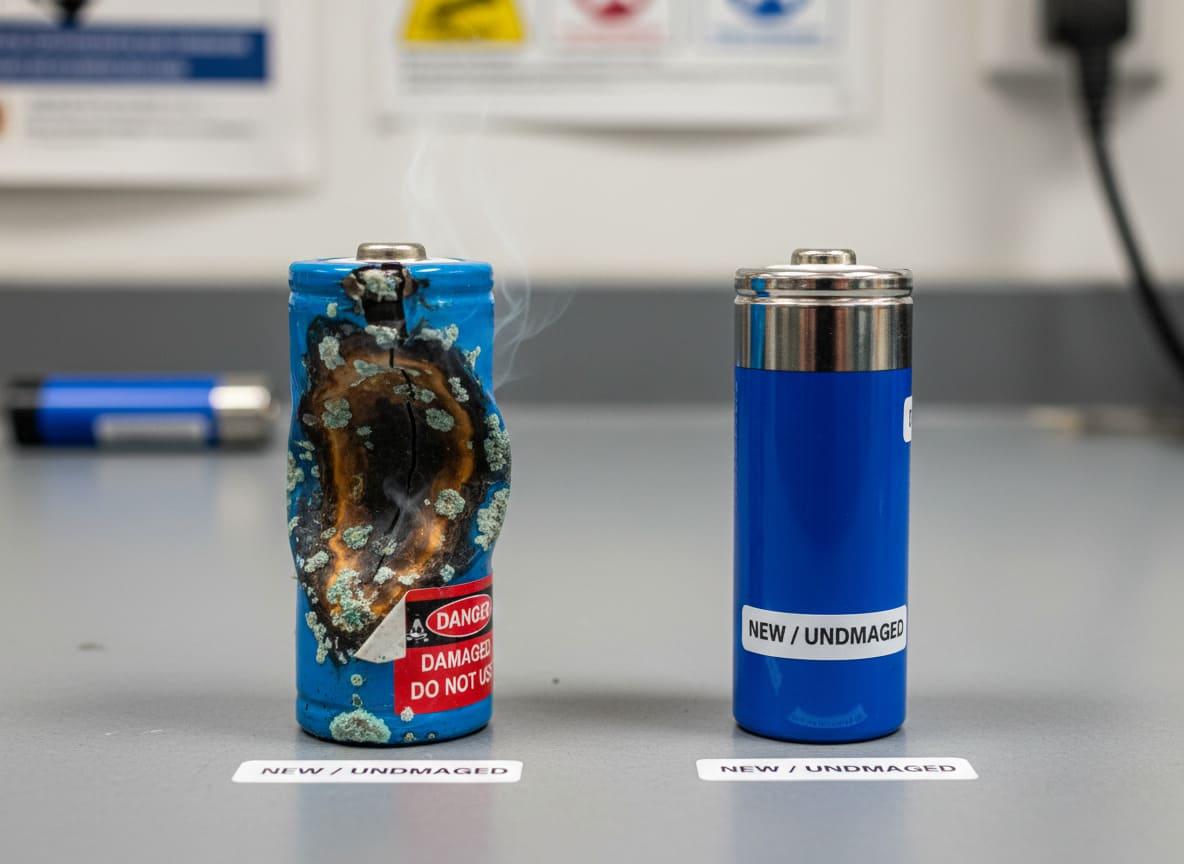
I often get questions from clients about whether a battery can be saved after water exposure. My answer for saltwater is always the same: no. The risk is simply too high, and the damage is not just on the surface. Even if a battery looks fine after drying, its internal chemistry has been permanently and dangerously altered.
Why "Rescuing" It Is a Myth
The popular trick of putting electronics in a bag of rice might absorb some surface moisture, but it does nothing to fix the real problem.
- Salt Residue: When saltwater dries, it leaves behind a layer of salt crystals. Salt is hygroscopic, which means it attracts moisture from the air. It is also conductive. This residue creates new, unintended electrical pathways on the circuit boards and inside the battery pack.
- Hidden Corrosion: You cannot see what is happening inside the sealed battery cell. The corrosive chloride ions have already started to eat away at the delicate internal structures. This damage is progressive and cannot be stopped. A battery that seems to work one day could fail catastrophically the next.
Obvious Signs of Permanent Damage
While you should always assume a saltwater-soaked battery is ruined, there are some clear visual signs that confirm it. If you see any of these, you must handle the battery with extreme caution.
- Swelling or Bloating: This is a major red flag. It means that internal chemical reactions are producing gas. A swollen battery is under pressure and has a high risk of rupturing or catching fire.
- Corrosion: Look for white, green, or bluish crusty buildup on the metal contacts or seams of the battery. This is a clear sign of chemical corrosion.
- Unusual Heat: If the battery feels warm or hot to the touch even when it is not being used or charged, it has a dangerous internal short circuit.
- Strange Odor: A sharp, acidic, or metallic smell indicates that the electrolyte inside the battery is leaking. These chemicals are toxic and flammable.
At Litop, our priority is the safety and reliability of our products. The cost of a new battery is tiny compared to the potential cost of a fire. It is never worth the risk.
Under what conditions is a lithium battery most likely to experience thermal runaway or catch fire?
The words "battery fire" are terrifying, and for good reason. You need to know what causes it. Understanding the main triggers is the first step to preventing a disaster from happening.
Thermal runaway is most likely triggered by three main conditions: a severe internal or external short circuit (like from saltwater), physical damage like a puncture, or overcharging. Each of these events can generate enough heat to start an uncontrollable, self-sustaining chemical reaction that leads to fire.
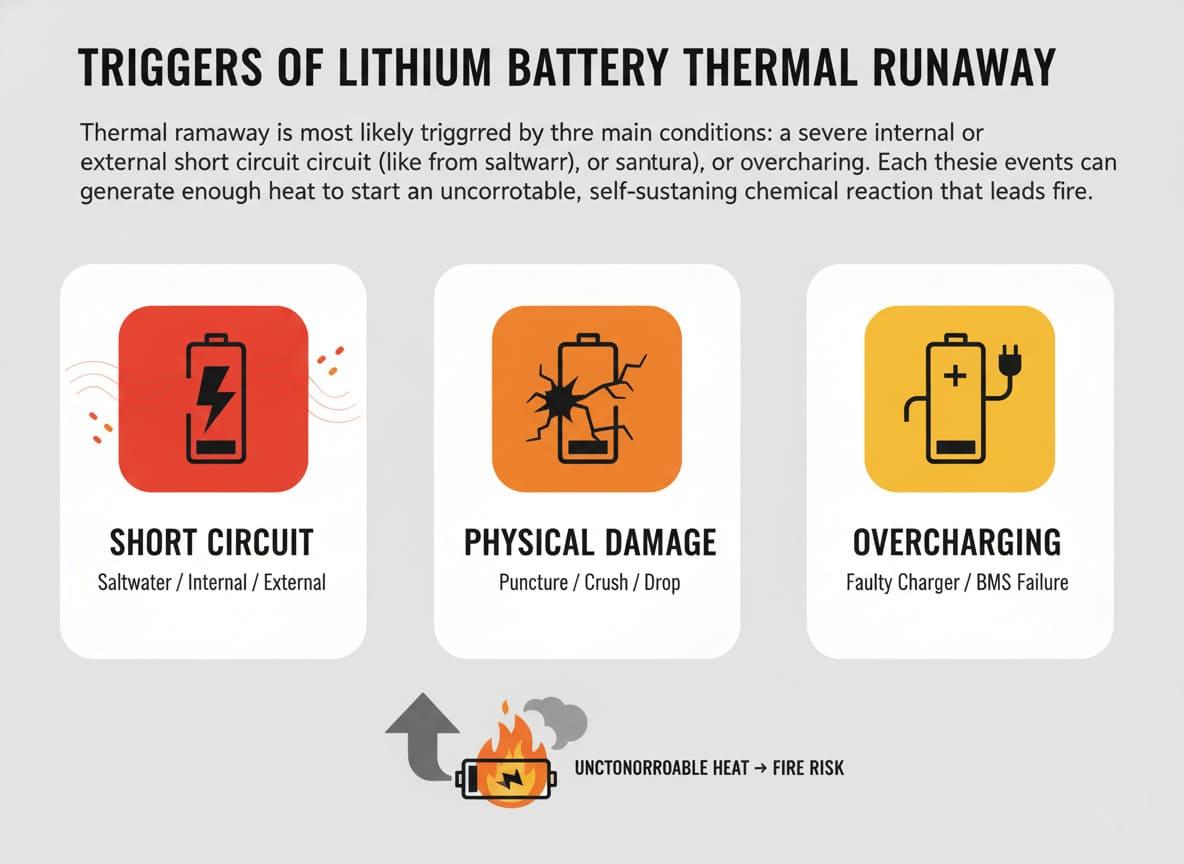
Thermal runaway is a chain reaction. It starts when a part of the battery gets too hot. This heat causes a chemical reaction that creates even more heat, which spreads to the next part of the battery, and so on. It happens very fast and is almost impossible to stop once it starts. In my years of experience, I have seen that almost all incidents can be traced back to one of three root causes.
Trigger 1: Short Circuits
A short circuit happens when electricity is allowed to flow in an uncontrolled way.
- External Short: This is exactly what happens with saltwater. A conductive liquid connects the positive and negative terminals, creating a massive flow of current and generating intense heat.
- Internal Short: This can be caused by a tiny flaw during manufacturing or from physical damage. The thin separator sheet between the positive and negative layers inside the battery gets breached, and they touch directly.
Trigger 2: Physical Damage
Lithium batteries are built with very thin layers. If the battery is punctured, crushed, bent, or dropped hard, these internal layers can be damaged. This can cause an immediate internal short circuit, which is one of the fastest ways to trigger thermal runaway. This is why you must never use a battery that is swollen or has been physically damaged.
Trigger 3: Overcharging and Overheating
- Overcharging: Pushing too much electrical energy into a battery is very dangerous. It causes the materials inside to become unstable and decompose, releasing gas and a lot of heat. This is why a high-quality Battery Management System (BMS) is so important. At Litop, our BMS designs are a core part of our products, providing critical protection against overcharging.
- External Heat: Storing or using a battery in a very hot environment, like a car on a summer day, can also be a trigger. If the battery's internal temperature gets too high, it can start the thermal runaway process on its own.
| Trigger | How It Works | Prevention Method |
|---|---|---|
| Short Circuit | Uncontrolled current flow generates heat. | Keep away from metal and conductive liquids. |
| Physical Damage | Puncture or crush causes internal short. | Handle with care; do not use if damaged. |
| Overcharging | Excess energy makes chemicals unstable. | Use a quality charger and a battery with a BMS. |
Conclusion
In short, saltwater is extremely dangerous for lithium batteries because it is very conductive. Always treat a saltwater-exposed battery as a total loss. Prioritize your safety, handle it carefully, and dispose of it properly. For reliable and safe battery solutions, you can count on us at Litop.