Worried your wet electronic device might be a fire hazard? You've seen the news about lithium battery fires and now fear the worst. Let's clear up the confusion.
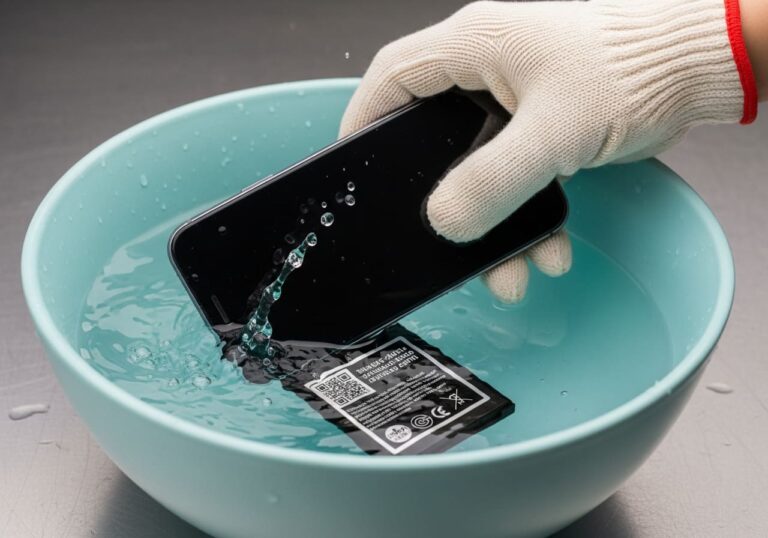
Generally, an undamaged lithium battery will not catch fire just from getting wet. The real danger comes from water seeping into a damaged battery, which can cause a short circuit and lead to thermal runaway. Proper handling is crucial to prevent any fire risk.

It's a question I get all the time, especially from clients like Michael in the medical device field where reliability is non-negotiable. They need to know the exact risks. The simple answer is "it depends," but that's not very helpful, is it? So, let's break down exactly what happens when a lithium battery meets water and what you should do about it. The details might surprise you.
How should I safely handle and dispose of a lithium battery if it accidentally falls into water?
A battery has just taken a dive, and you're frozen with uncertainty. One wrong move could lead to a short circuit or worse. Here’s your immediate, safe action plan.
First, do not attempt to use or charge it. Immediately remove the battery if possible and place it in a well-ventilated, dry area away from flammable materials. Observe it for signs of damage like swelling or leaking. For disposal, contact your local hazardous waste facility.

My first piece of advice is always the same: put safety first. When a battery gets wet, your immediate goal is to prevent a short circuit. Do not try to turn the device on or plug it in to charge. If you can, remove the battery from the device immediately. Once removed, place it in a safe, dry, and well-ventilated location. Keep it far away from anything flammable. A metal bucket with sand or a ceramic pot are good temporary containers.
Next comes the observation period. A wet battery isn't instantly safe, even after you've dried the outside. You need to monitor it for at least 24 to 48 hours for any danger signs.
Key Warning Signs to Watch For
- Swelling: If the battery starts to bulge or puff up, it's a sign that internal gases are forming. This is extremely dangerous.
- Heat: The battery should not feel warm or hot to the touch on its own. If it does, a chemical reaction is happening inside.
- Leaks: Any fluid seeping from the battery means the internal seals have failed. This liquid is corrosive and flammable.
If you see any of these signs, the battery is damaged beyond repair and is a safety risk. It must be disposed of properly. Never throw lithium batteries in the regular trash. They are considered hazardous waste. You should take it to a designated battery recycling center or a local hazardous waste disposal facility. For our B2B clients, we provide detailed safety and disposal protocols as part of our one-stop battery solution service.
| Step | Action | Why It's Important |
|---|---|---|
| 1. Isolate | Immediately remove the battery and place it in a dry, ventilated area away from combustibles. | To prevent a short circuit and minimize fire risk if the battery fails. |
| 2. Observe | Monitor the battery for 24-48 hours for swelling, heat, or leaks. | Damage may not be immediately apparent. A delayed reaction is possible. |
| 3. Dispose | Take the battery to a certified hazardous waste or e-waste facility. | To prevent environmental contamination and fires in sanitation trucks or landfills. |
What is the difference in danger between fresh water and salt water for a lithium battery?
Does it matter if your device fell in a lake or the ocean? You might think water is just water, but this difference is critical and dramatically increases the risk.
Salt water is significantly more dangerous than fresh water for a lithium battery. The high conductivity of salt water creates a much faster and more aggressive path for a short circuit between the battery terminals, greatly increasing the risk of rapid discharge, overheating, and fire.
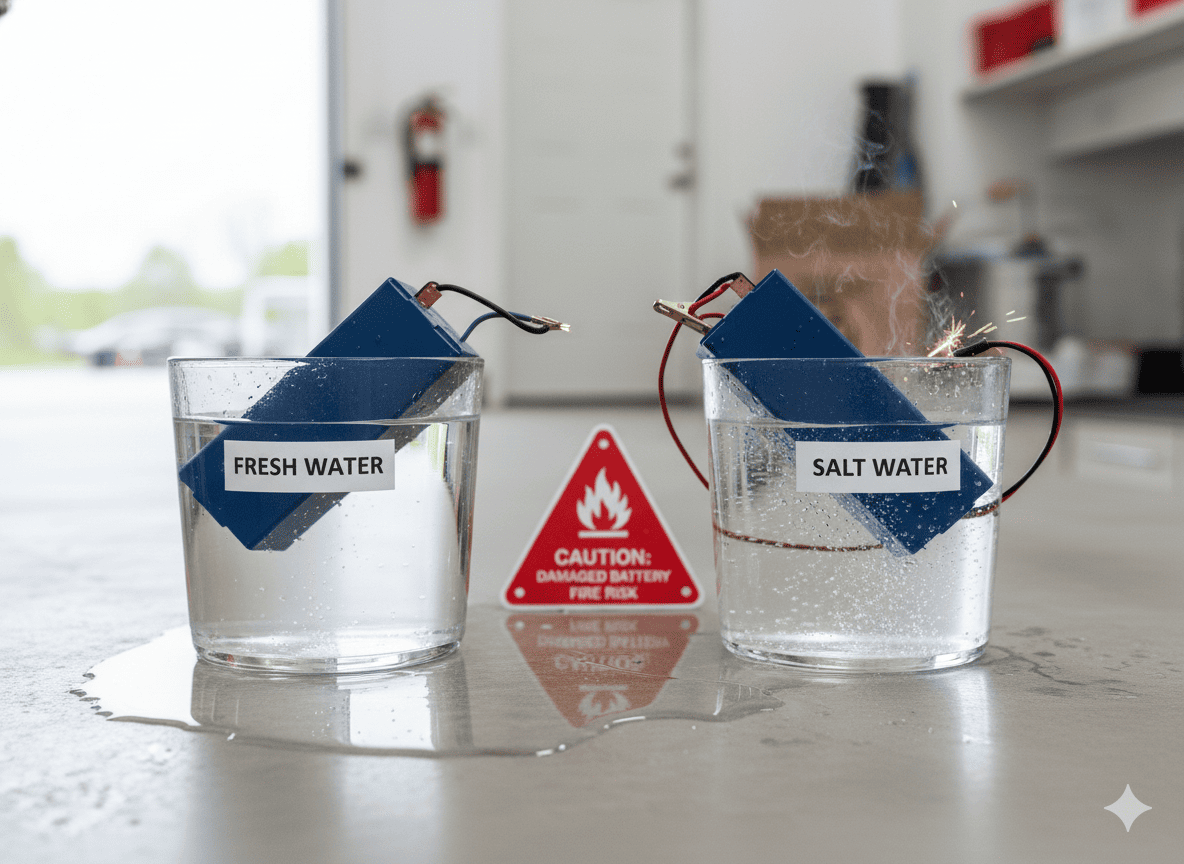
The key difference comes down to one word: conductivity. Electricity needs a path to travel, and some materials make for better paths than others. Pure water is actually a poor conductor of electricity. Fresh water from a tap or a lake contains some minerals and impurities, so it's slightly conductive, but not by much. If a battery is exposed to fresh water, the primary risk is that the water will slowly seep past the seals and cause internal corrosion or a short circuit over time. The immediate external short-circuit risk is relatively low unless the terminals are very close together.
Salt water is a completely different story. When salt dissolves in water, it breaks down into charged ions. These ions make the water an excellent conductor of electricity. When a battery is submerged in salt water, the water acts like a wire connecting the positive and negative terminals. This creates a powerful and immediate short circuit. The battery begins to discharge its energy very rapidly through the salt water, generating a massive amount of heat in a short period. This intense heat is a direct path to thermal runaway, where the battery's internal temperature rises uncontrollably, often leading to smoke, fire, or even an explosion.
I remember a client who was developing a marine sensor. Their first prototype failed dramatically during testing because of a small leak in the housing. The saltwater intrusion caused the battery to short out and overheat almost instantly. That experience taught us a crucial lesson. We worked with them to integrate one of our custom waterproof lithium battery packs with an IP68 rating, completely solving the problem. It highlights why understanding the operating environment is so critical in battery design1.
| Factor | Fresh Water Exposure | Salt Water Exposure |
|---|---|---|
| Conductivity | Low | Very High |
| Risk of Short Circuit | Moderate, usually requires internal ingress | Extremely High, can happen externally |
| Speed of Damage | Slow, occurs over hours or days | Fast, can occur in seconds or minutes |
| Primary Danger | Long-term corrosion, internal shorting | Rapid overheating, thermal runaway, fire |
How can I tell if a wet battery is damaged or safe to air-dry and use again?
Your battery seems fine after drying out, and you're tempted to reuse it. But is it a ticking time bomb? Using a compromised battery is a gamble you can't afford.
Look for any physical changes: swelling or puffiness, dents, punctures, or discoloration, especially around the terminals. If the battery feels hot to the touch or you see any fluid leakage, it is damaged and unsafe. When in doubt, always err on the side of caution and replace it.

In my eight years in the battery industry, I've learned one simple rule: when in doubt, throw it out. A lithium battery is a consumable part. The cost of replacing it is tiny compared to the potential cost of a fire or a destroyed device. However, if you must assess a battery after it has been wet and air-dried, there is a strict visual inspection checklist you must follow.
First and foremost, look for swelling. If the battery case is puffed up or feels bloated, it is absolutely unsafe. This swelling is caused by gas generated from unwanted chemical reactions inside the battery, often triggered when water reacts with the electrolyte. A swollen battery is under internal pressure and is highly unstable. Do not try to use it, charge it, or puncture it.
Next, check for any signs of corrosion. This often looks like a white or greenish-blue crusty buildup, especially around the metal contact points or terminals. Corrosion indicates that a chemical reaction has occurred and that the battery's seals were likely breached. This corrosion can also prevent a proper electrical connection, even if the battery itself still holds a charge.
Finally, perform a thorough physical inspection. Look for any dents, punctures, scrapes, or warping of the battery's casing. A battery that was already physically weak might have finally failed when exposed to water. Also, look closely for any signs of leaks. An odd chemical smell or any visible moisture coming from the seams is a clear indicator that the internal integrity is gone. If a battery displays any of these symptoms, it has failed the inspection and must be disposed of safely. It is not worth the risk to try and use it again. This is why we emphasize robust housing and sealing in our custom battery designs at Litop, especially for applications in medical or wearable devices where reliability is paramount.
Under what circumstances are lithium batteries most likely to experience thermal runaway or catch fire?
The term "thermal runaway" sounds scary, but what does it actually mean? Ignoring the specific triggers is like walking through a minefield blindfolded. Let's illuminate the exact causes.
Thermal runaway is most often caused by four things: physical damage (like being punctured), overcharging, exposure to extreme heat, and internal short circuits due to manufacturing defects. Water can contribute by causing a short circuit, but these other factors are the primary culprits of battery fires.
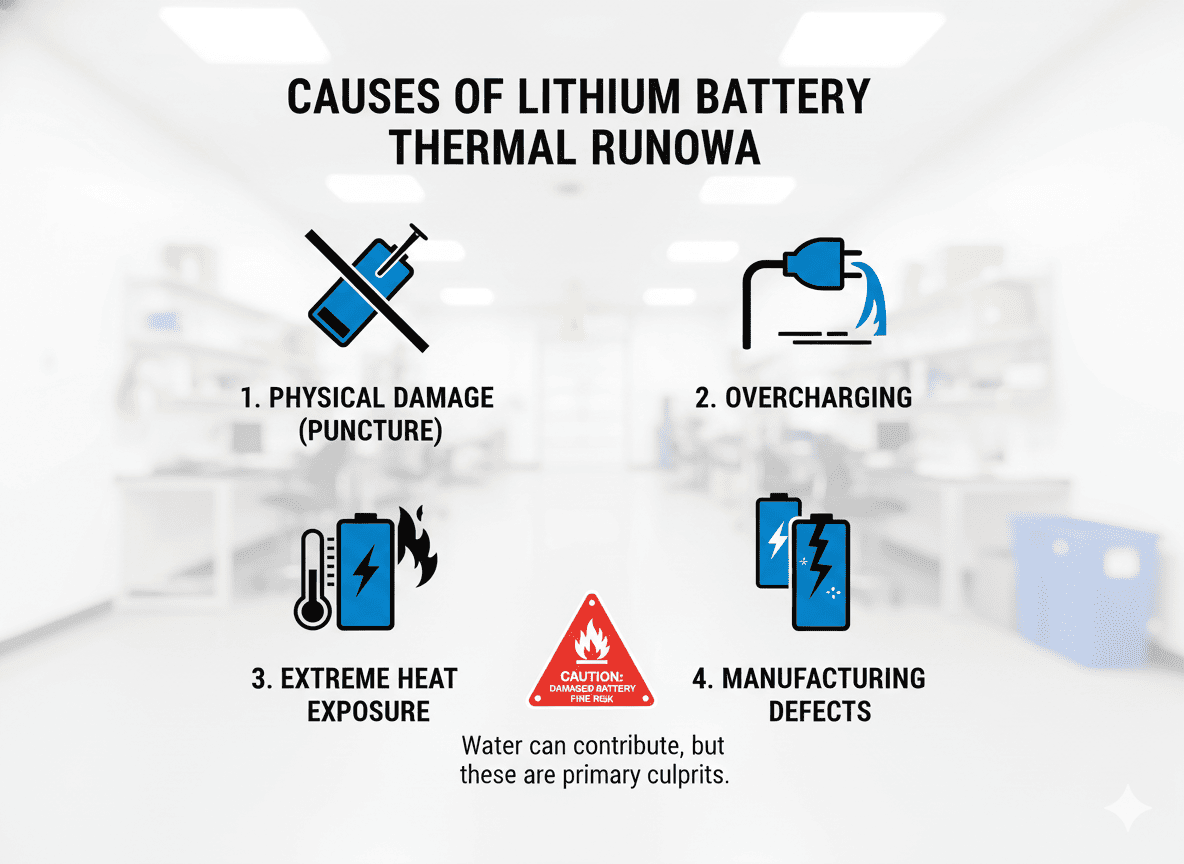
Thermal runaway is a chain reaction. Heat builds up inside a battery faster than it can escape, causing the internal temperature to rise. This increased temperature speeds up the chemical reaction, which produces even more heat. It's a vicious cycle that can end in fire or an explosion. Water is an external factor that can initiate one of these failure modes, but the root causes are usually one of the following four issues.
- Physical Damage: This is the most violent and rapid trigger. If a battery is punctured, crushed, or severely bent, the thin separator sheet between the internal layers (the anode and cathode) can be torn. This creates a massive internal short circuit, and all the battery's stored energy is released almost instantly as heat.
- Overcharging: Every lithium battery needs a Battery Management System (BMS). It's the battery's brain. A quality BMS will stop the charging process once the battery is full. If the BMS fails or you use a low-quality, incorrect charger, the battery can be overcharged. This causes the internal chemistry to become unstable, leading to heat generation and potential failure. At Litop, our team of 30 R&D engineers places a huge emphasis on designing robust and reliable BMS circuits to prevent this.
- Exposure to High Heat: Leaving a battery-powered device in a hot car is a classic example. High external temperatures can raise the battery's internal temperature to an unsafe level. Once it passes a certain threshold, the chemical reactions inside can become self-sustaining and start the thermal runaway process on their own.
- Manufacturing Defects: This is the most difficult one to guard against as a user. Tiny, microscopic metal particles or imperfections within the battery cell can create a small, slow-growing internal short circuit. Over many charge cycles, this tiny short can worsen until it eventually triggers thermal runaway. This is why choosing a supplier with an intense focus on quality is so important. Our 15-person quality control team and ISO9001-certified processes are in place specifically to catch these potential issues before a battery ever reaches a client.
| Trigger | Description | How to Prevent |
|---|---|---|
| Physical Damage | Puncturing or crushing the battery, causing an internal short circuit. | Handle batteries and devices carefully. Do not use a damaged battery. |
| Overcharging | Charging the battery beyond its maximum safe voltage. | Use the correct, high-quality charger and rely on a well-designed BMS. |
| External Heat | Exposing the battery to high ambient temperatures (e.g., a hot car). | Keep devices in cool, shaded environments. |
| Internal Defect | An invisible flaw from the manufacturing process. | Source batteries from reputable manufacturers with strict quality control. |
Conclusion
So, can a wet lithium battery catch fire? It’s unlikely if the battery is undamaged. The real dangers are short circuits from damage or saltwater. Always handle wet batteries with caution, prioritize safety, and when in doubt, replace them. Your safety is worth more than a battery.
Explore best practices in battery design to enhance safety and reliability in applications. ↩