Worried your power bank will be taken at the airport? New 2026 rules can be confusing. Let's break down how to fly with your charger, hassle-free and with complete confidence.
Yes, you can bring a power bank, but only in your carry-on bag. For 2026, it must be 160Wh or less. A new rule requires standalone power banks to be charged to 30% or less. Never put them in checked luggage.
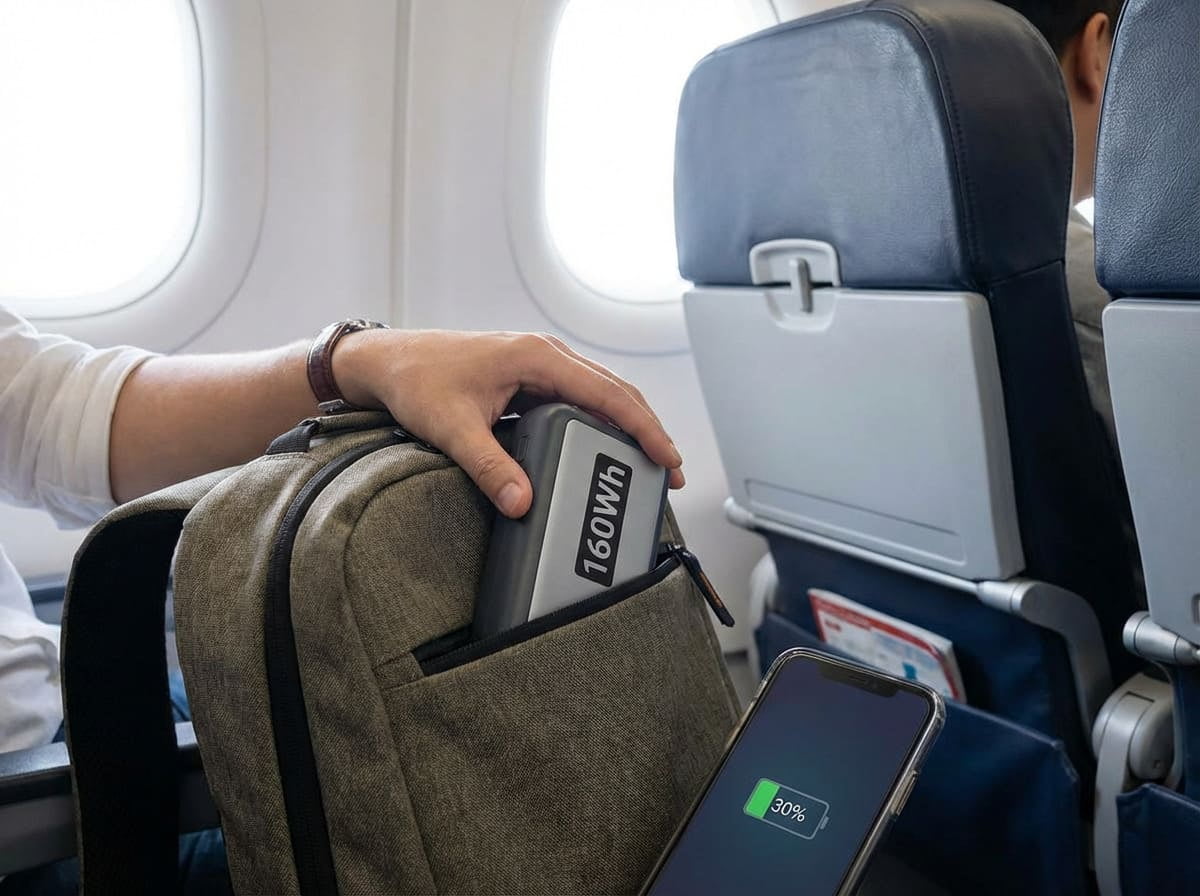
In today's connected world, a power bank is a travel essential. I can't tell you how many times a fully charged power bank has saved me during long layovers or after landing in a new country. But the rules for flying with them can feel like a maze. It’s not just about whether you can bring it, but about its capacity, its markings, and even how much charge it has. Let's get into the details so you're fully prepared for your next trip and can avoid any unpleasant surprises at the security checkpoint.
Will my power bank be confiscated if it has no watt-hour (Wh) rating?
Is the label on your power bank worn out or missing? Security won't take chances with unmarked batteries and might confiscate it. Here's what you need to know to avoid this problem.
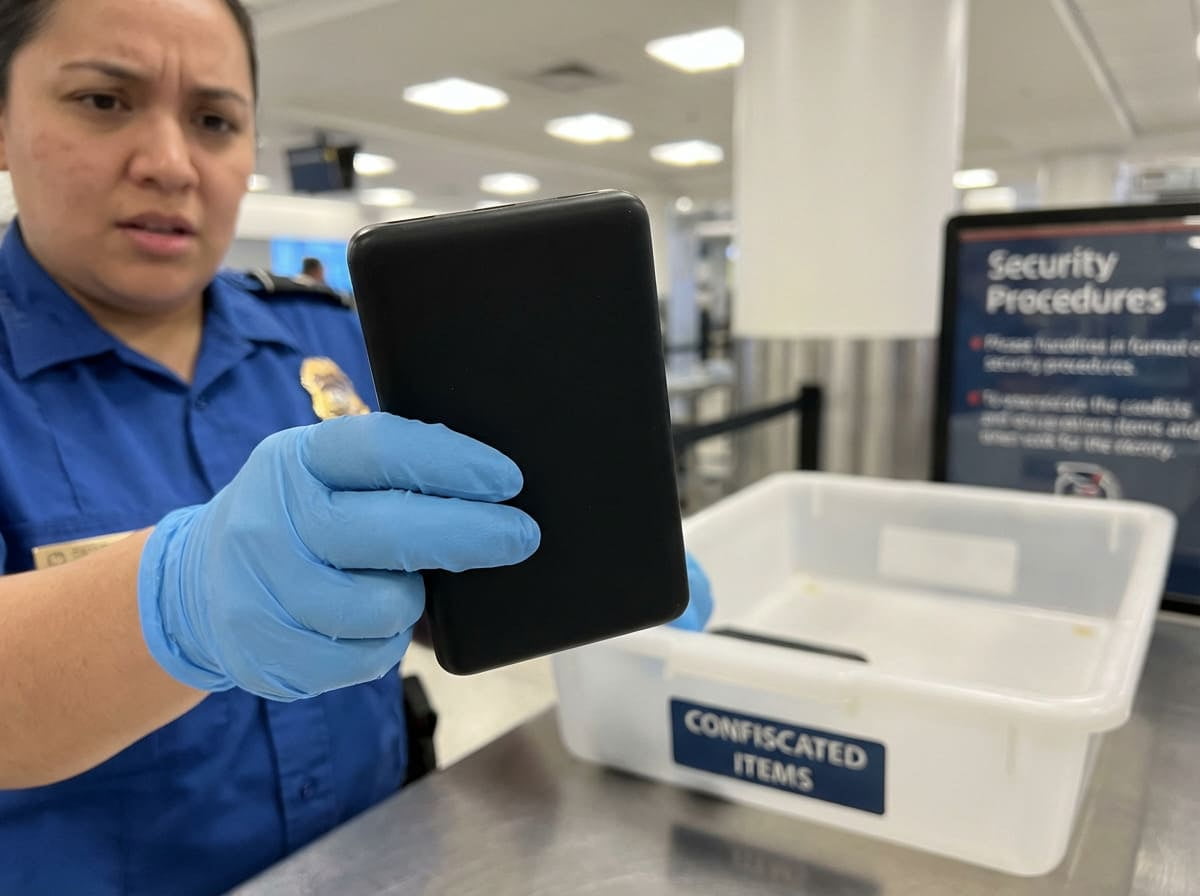
Yes, an unmarked power bank will likely be confiscated. Security staff must verify its watt-hour (Wh) rating is under the legal limit. Without clear markings, they can't approve it. It's best to travel with a clearly labeled power bank to avoid issues.
Why Clear Markings Are Non-Negotiable
When you go through airport security, the officers are trained to look for specific information on electronics, especially those with lithium batteries. The watt-hour (Wh) rating is the most important number on your power bank. This number tells them the total energy stored inside. Both the TSA and the International Air Transport Association (IATA) have strict rules based on this rating. If an officer cannot see the Wh rating clearly printed on the device's casing, they have no way to know if it's safe to fly. They will assume the worst to ensure the safety of everyone on the plane. In my experience dealing with battery logistics, unlabeled products are an immediate red flag for regulators. It's an issue of compliance and safety, and there is no room for guesswork.
How to Calculate Watt-Hours (Wh) Yourself
If your power bank shows other information but not the watt-hours, you might be able to calculate it yourself. This is useful knowledge, though it won't help if the label is completely blank. The formula is quite simple:
(Milliamp-hours / 1000) x Voltage = Watt-hours
or (mAh / 1000) * V = Wh
Most power banks have a standard voltage of 3.7V. Let's look at a common example:
- A 20,000mAh power bank: (20,000 / 1000) * 3.7V = 74Wh. This is well under the 100Wh limit.
Here is a quick reference table:
| Capacity (mAh) | Standard Voltage (V) | Calculated Watt-Hours (Wh) |
|---|---|---|
| 10,000mAh | 3.7V | 37Wh |
| 20,000mAh | 3.7V | 74Wh |
| 26,800mAh | 3.7V | 99.16Wh |
| 30,000mAh | 3.7V | 111Wh |
What To Do If Your Power Bank Is Unmarked
My best advice is simple: do not travel with an unmarked power bank. The risk of it being confiscated is just too high. It's better to invest in a new, compliant power bank from a reputable brand. At Litop, we ensure every battery we produce has clear, accurate, and durable labeling to meet all international travel and safety standards. This is critical not just for consumer products but especially for our B2B clients in the medical and IoT fields, where compliance is everything.
Is a 20,000mAh or 30,000mAh power bank the maximum you can carry without airline approval?
Trying to pick the biggest power bank for your trip? If you choose one that's too powerful, you could face delays or even have it taken away by security. Let's define the actual limit.
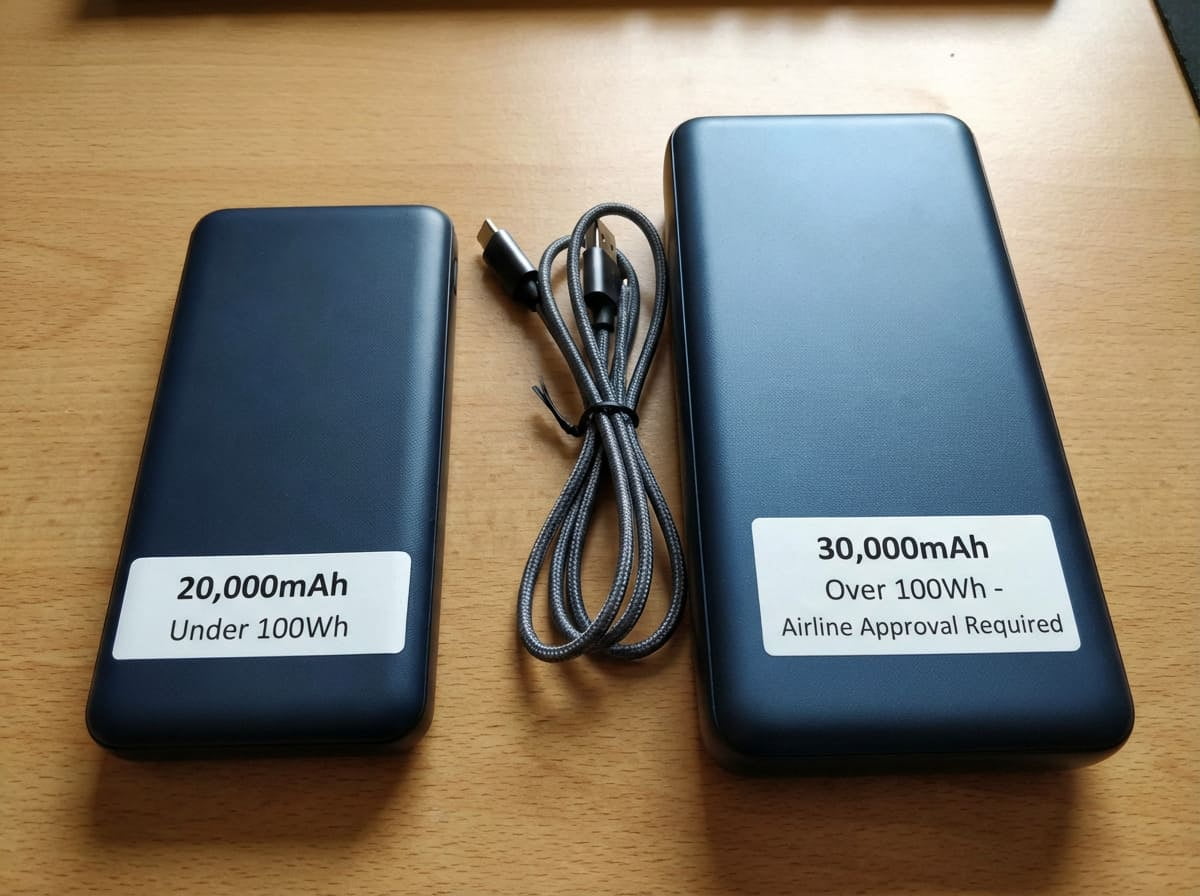
The limit for carry-on without airline approval is 100 watt-hours (Wh), not mAh. A 20,000mAh power bank is typically under this limit. However, a 30,000mAh unit usually exceeds 100Wh, meaning you must get airline permission before flying with it.
Why Watt-Hours (Wh) Matter More Than mAh
Many people focus on the milliamp-hour (mAh) rating because it's the biggest number advertised on the box. It tells you about the battery's charge capacity, which relates to how many times you can charge your phone. However, for aviation safety, the critical measure is watt-hours (Wh). Watt-hours represent the total amount of energy stored in the battery. A higher energy content means a greater potential fire risk if the battery malfunctions. This is why regulators like the FAA and IATA base their rules on Wh. Think of it this way: mAh is the size of the gas tank, but Wh is how much explosive power that gas has. The voltage of the battery is the key factor that converts mAh to Wh, and security officials only care about the final energy number.
Breaking Down the Capacity Tiers
The rules are divided into three clear tiers. It's essential to know which category your power bank falls into before you get to the airport.
| Watt-Hour (Wh) Rating | Status | Quantity Limit |
|---|---|---|
| Up to 100Wh | Allowed in carry-on | No specific limit |
| 100Wh to 160Wh | Airline approval required | Maximum of 2 per person |
| Over 160Wh | Forbidden | Not allowed on aircraft |
A Real-World Example
Let's see how this applies to the question of 20,000mAh versus 30,000mAh. Using our standard 3.7V calculation:
- 20,000mAh Power Bank: This comes out to 74Wh. It falls safely in the "Up to 100Wh" tier. You can pack this in your carry-on bag without needing to ask the airline for permission.
- 30,000mAh Power Bank: This calculates to 111Wh. This is over the 100Wh limit, placing it in the "100Wh to 160Wh" tier. You must contact your airline before your flight to get approval to bring this power bank. Don't just show up at the airport with it.
As a battery manufacturer at Litop, we often advise our clients to design products around batteries just under the 100Wh threshold. This is why many of the largest consumer power banks on the market are specifically rated at 26,800mAh or 27,000mAh—it keeps them right under that 100Wh limit for hassle-free travel.
Is there a limit to how many power banks I can bring on a plane?
Packing for a long trip and need multiple power banks for all your gadgets? You might worry that bringing too many will cause problems at security. Let's clarify the rules on quantity.
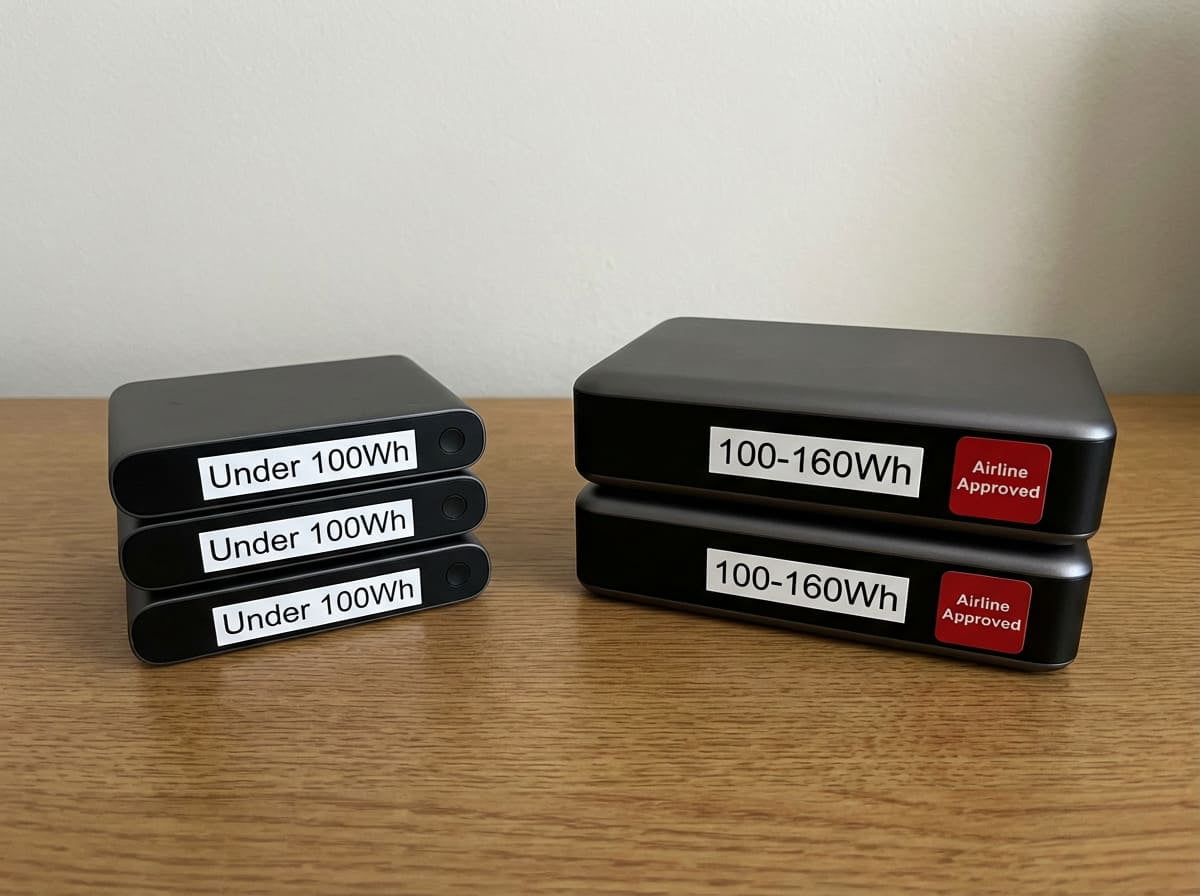
For power banks under 100Wh, there's no strict number limit, but it should be a 'reasonable amount' for personal use. For larger power banks between 100Wh and 160Wh, you are strictly limited to carrying a maximum of two, and only with airline approval.
The "Reasonable Amount" Rule for <100Wh Power Banks
For the most common power banks—those under the 100Wh limit—the regulations don't set a hard number. Instead, they use the term "a reasonable quantity for personal use." This is intentionally a bit vague and leaves the final decision to the security officer. For a typical traveler, carrying two, three, or even four power banks for your phone, tablet, and headphones is completely normal and won't raise any flags. However, if you show up with a bag containing 20 power banks, the security staff might suspect you are transporting them for commercial resale without proper declaration. I once traveled to a trade show with five sample battery packs for a client presentation. They were all under 100Wh. I kept them in separate, clear bags and had our product specification sheets ready. The officer did ask about them, but after a brief explanation, I was cleared to proceed. The key is transparency and having a logical reason.
The Strict Limit for 100-160Wh Power Banks
This is where the rule becomes very clear and strict. For larger power banks that fall into the 100-160Wh category, you are limited to a maximum of two per person. This is not a guideline; it's a firm rule from IATA. Remember, each of these power banks also requires you to get pre-approval from your airline. You cannot bring a third one, even if the airline approves it. The system is designed to cap the total potential energy risk per passenger. Attempting to bring more than two will result in them being confiscated.
Why Quantity is Regulated
The reason behind these limits is all about managing risk. Every lithium-ion battery carries a small but real risk of a malfunction called thermal runaway, which can lead to a fire. While a single battery fire is manageable for a trained cabin crew, multiple simultaneous incidents would be far more dangerous. By limiting the number and size of batteries each passenger can bring, airlines are effectively limiting the total amount of stored energy—and therefore the total potential fire risk—in the aircraft cabin. It's a critical safety measure that helps ensure everyone has a safe flight.
Why must power banks be carried on, and are you really forbidden from using them on the plane?
It feels contradictory: power banks must be in the cabin with you, but then you hear you shouldn't use them. This common point of confusion makes the rules seem confusing. I'll explain the safety logic.
Power banks are in carry-on luggage so if they overheat or catch fire, the cabin crew can extinguish it immediately. In the cargo hold, a fire could go undetected. Using them to charge your devices is usually fine, but some specific rules may apply.
The Unseen Danger in the Cargo Hold
The single most important rule is that lithium-ion batteries like those in power banks are forbidden in checked luggage. The reason is simple: fire risk. If a battery malfunctions, it can enter a state called thermal runaway. This is a chain reaction where the battery heats up uncontrollably, venting hot, flammable gases and potentially catching fire. In the passenger cabin, a flight attendant can see smoke or a passenger can smell the distinct odor of a failing battery. They can then act immediately. However, the cargo hold is a different story. It is unobserved, and while it has fire suppression systems, they are not designed to handle the intense, self-oxidizing fires of lithium batteries, which can even re-ignite after being extinguished. A fire in the cargo hold could be catastrophic.
The Cabin Crew: Your First Line of Defense
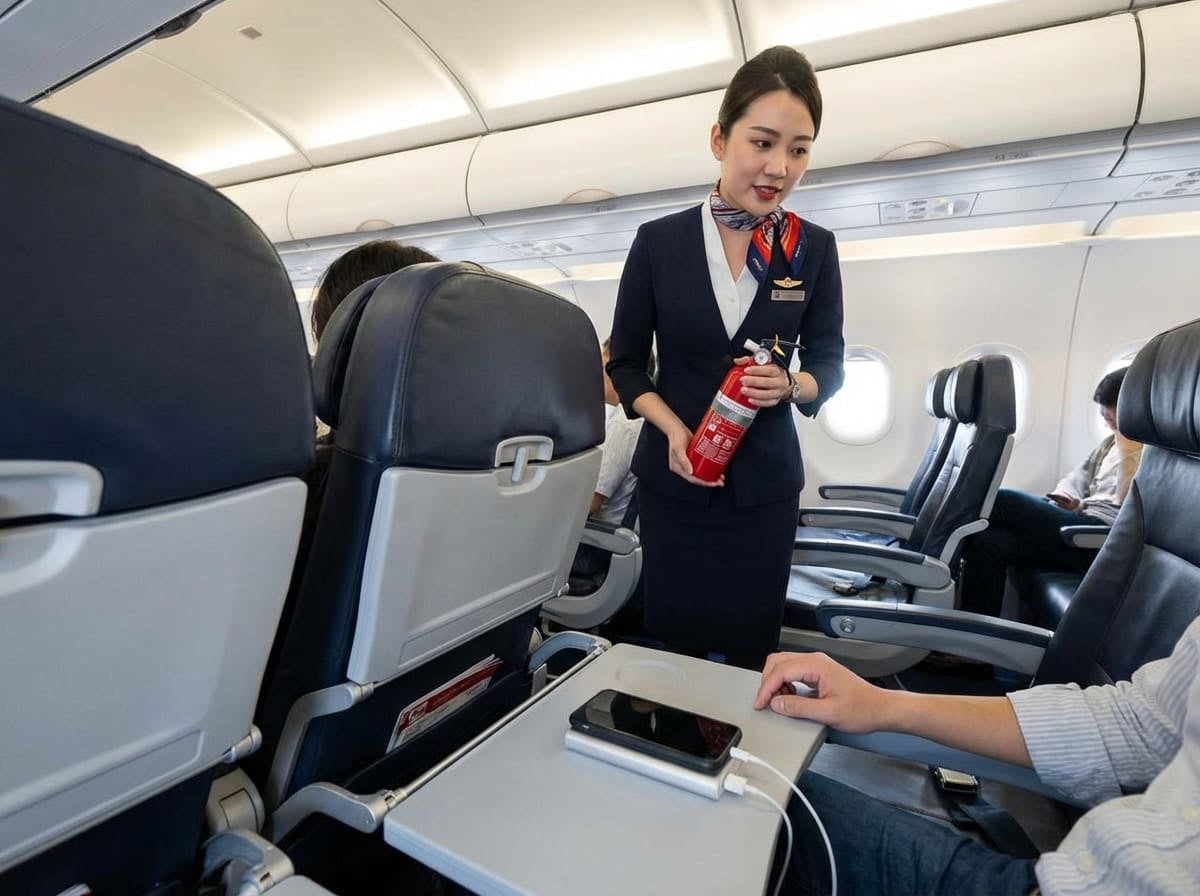
Keeping power banks in the cabin puts them in an environment where a potential incident can be managed. Flight attendants are extensively trained to handle in-flight fires, including those caused by batteries. They have access to specialized equipment like Halon fire extinguishers and fire containment bags. These bags are designed to safely hold a burning or overheating device, containing the flames and heat until the plane can land safely. By having your power bank in your carry-on, you are essentially keeping it where the first responders can get to it. This simple rule is one of the most effective safety measures in modern aviation.
The Rules Around In-Flight Usage
There is a lot of misinformation about using power banks during a flight. Let me clarify: most major airlines allow you to use your power bank to charge your devices (phone, tablet, etc.) while in the air. The main concern is heat. When a power bank is charging a device, it generates heat. If it's tucked away in a cramped bag or covered by a blanket, it could overheat. It's always best to keep it in a well-ventilated spot, like on your tray table. The rule you may have heard about "no charging" usually refers to one of two things: a specific airline's policy (which is rare) or a prohibition against charging the power bank itself using the plane's in-seat USB ports. The new 2026 rule requiring a starting charge of 30% or less further emphasizes that the goal is to minimize stored energy, making them safer from the start of the journey.
Conclusion
To fly with your power bank in 2026, remember these key rules: carry-on only, capacity under 160Wh, and charge level at 30% or less for standalone units. Always check your power bank's labels and consult your airline for a smooth and safe journey.